
How to Turn Wearable Data Into a Personal Longevity Protocol
Wearables and smart rings collect thousands of health and performance data points every week. The challenge for clinicians and users alike is knowing how to extract meaningful insights from that data pool.
A personal longevity protocol turns wearable data into repeatable decisions. Instead of trying to maximize every score, you establish your normal range, identify the metrics best aligned with long-term health and test habits that lead to improvements over time.
The most useful wearable metrics for longevity are not necessarily the most sophisticated. Daily movement, cardiorespiratory fitness, sleep cadence and recovery trends all provide actionable information. The goal is to compare your data against your own baseline and use population research to establish feasible benchmarks to strive for.
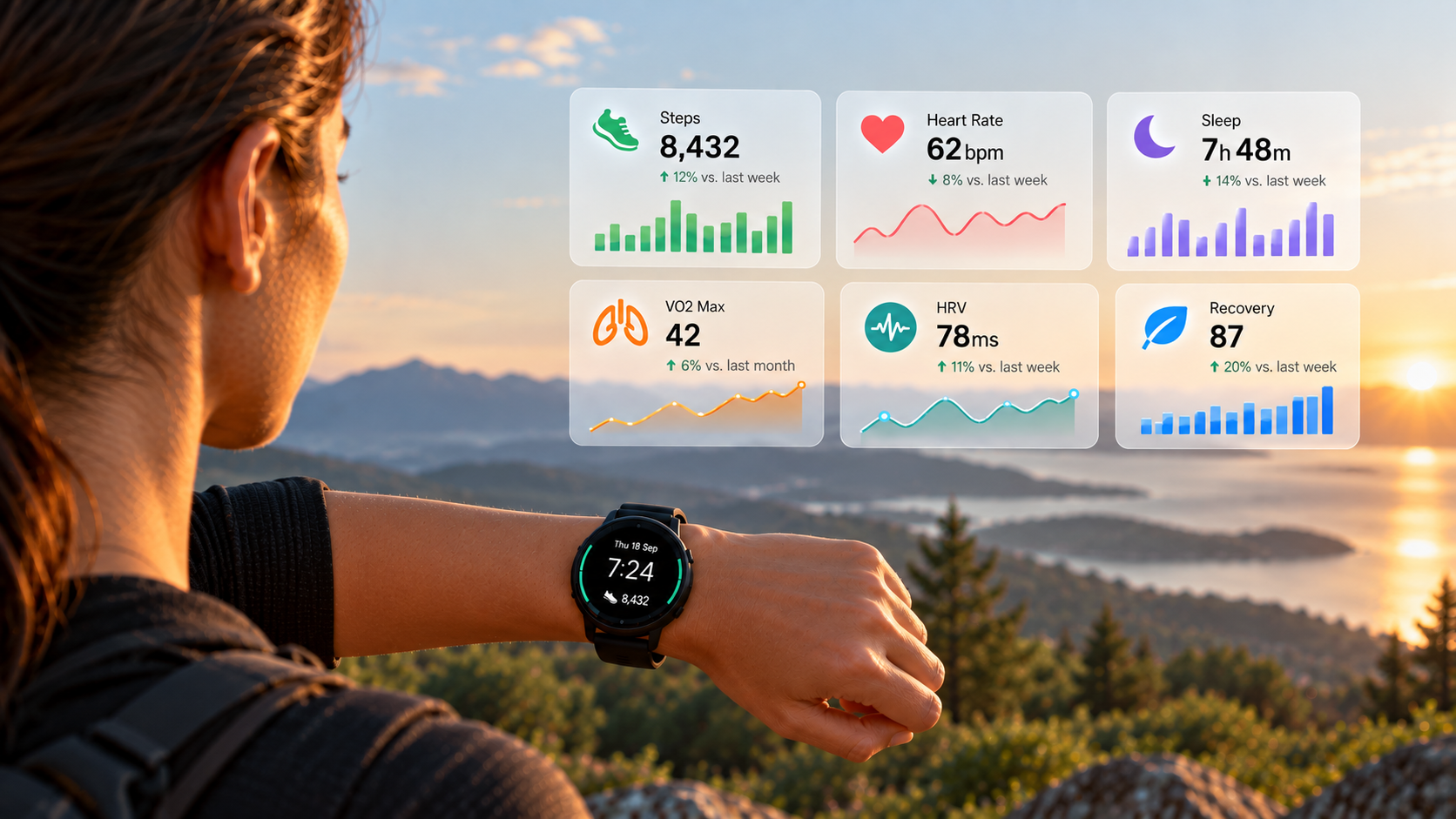
Which metrics matter most for longevity?
Obviously there is no single metric that measures longevity. That said, research does provide useful evidence around several measurements that wearables can track or estimate.
| Metric | What research tells us | Device source |
|---|---|---|
| Daily step volume | In a meta-analysis of 15 cohorts covering 47,471 adults, mortality risk fell steadily up to roughly 6,000 to 8,000 steps a day for adults 60 and older and 8,000 to 10,000 for those under 60. The top three quartiles had a 40% to 53% lower risk of death vs. the lowest. | Accelerometer step count |
| Short, vigorous bursts | Brief everyday efforts like climbing stairs or walking uphill count. Among 22,398 non-exercising adults, 3.4 to 3.6 minutes a day was associated with a 17% to 18% reduction in total cancer risk. The median amount of 4.5 minutes saw a bigger, 31% to 32% reduction specifically for cancers linked to inactivity. | Heart rate plus motion intensity |
| Cardiorespiratory fitness | Among 122,007 adults given treadmill tests, low fitness carried a hazard ratio of 5.04 against elite fitness. The authors found no ceiling to the benefit. | Estimated VO2 max |
| Sleep regularity | Across 60,977 UK Biobank participants wearing accelerometers, the four most regular sleep quintiles had a 20% to 48% lower risk of all-cause mortality than the least regular. Sleep regularity was a stronger predictor than sleep duration. | Nightly sleep onset and wake times |
| HRV | HRV varies substantially between people, making personal trends more useful than population targets. Research using about 2 million nocturnal HRV readings found that at least five nights were needed to reliably estimate a seven-day HRV variability measure. | Nocturnal heart rate sensor (PPG) |
The cardiorespiratory fitness numbers above come from treadmill testing rather than a watch estimate. Most wearables now generate their own VO2 max figure from heart rate and pace, which is a reasonable stand-in but measured differently from a lab test.
Sleep regularity is the one most people overlook. Chasing an eight hour average while going to bed anywhere between 10pm and 2am is the wrong optimization. Understanding what your device is actually scoring makes the data far easier to interpret.
Wearing the device does some of the work by itself
There is decent evidence that tracking changes behaviour on its own. An umbrella review in Lancet Digital Health pooled 39 systematic reviews covering 163,992 participants and found that activity tracker interventions produced roughly 1,800 extra steps a day, about 40 extra minutes of walking and around 1kg of weight loss.
Pushing a passive tracker wearer from about 5,800 to 7,800 steps moves them from one risk quartile into the next. Getting from there to a protocol means deliberately setting targets rather than letting the device set them for you.
Pool the data before you try to interpret it
The interpretation problem is usually a plumbing problem. Sleep lives in one app, workouts in another and blood pressure or glucose somewhere else. The most meaningful insights often come from correlations across these sources, but those relationships are easy to miss when the data is fragmented.
The same principle applies when someone else is interpreting your data. Longevity clinics, sports scientists and personal trainers increasingly rely on unified dashboards instead of scattered screenshots and app logins. Platforms like Sonar Atlas bring wearable, workout and biomarker data together so professionals can monitor an entire roster from one view.
Start with your personal baseline
A common mistake with longevity protocols is trying to optimize before you know what your normal looks like. Record at least four weeks of data during your normal routine, then use those weekly averages to set baselines across your relevant metrics.
For steps and activity minutes, referencing population health studies may make sense. A recent meta-analysis of 57 studies across 35 cohorts found benefits across several health outcomes including all-cause mortality, cardiovascular disease and dementia. Risk reductions tended to level off somewhere between 5,000 and 7,000 steps per day. That does not make 7,000 a magic number. It suggests someone averaging 3,000 steps has more room to gain from added movement than someone already averaging 12,000.
For HRV, resting heart rate and other recovery metrics, your own range matters more than comparisons against a different demographic. This is especially true for heart rate variability, which depends heavily on individual physiology and can vary widely from person to person.
For sleep, weigh consistency alongside duration. A wearable study from the All of Us Research Program followed 6,785 participants for a median of 4.5 years and found that sleep irregularity was associated with higher odds of conditions including hypertension and obesity.
Once you know your baselines, you can identify which metrics have the most room for improvement. Population research can guide that process, but it should not set the rule for your individual case.
Run small experiments instead of changing everything
Wearable data becomes more valuable when you treat your routine like a series of controlled experiments.
Suppose your sleep duration is adequate but your schedule varies significantly. Try keeping your bedtime and wake time within a consistent window for two weeks. Then compare sleep regularity, resting heart rate and HRV with your previous baseline.
You can apply the same framework to increasing daily walking, reducing late alcohol intake or adjusting training volume.
Change one major variable at a time when possible. Otherwise, even if your metrics improve, you may not know what caused the change.
Remember that wearable data is not laboratory data
Wearable fitness estimates are directional. A 2025 validation study in PLOS One compared Apple Watch VO2 max estimates against laboratory indirect calorimetry and found a mean absolute percentage error of about 13%, with the watch underestimating by roughly 6 mL/kg/min on average.
The practical reading is that your absolute number may be wrong while the direction of travel is still informative. If your wearable reports a VO2 max increase from 40 to 40.5, that difference may not be meaningful. If the trend rises steadily from 40 to 45 over six months under similar measurement conditions, the signal becomes much more useful.
This article is for general information and is not medical advice. Speak to a qualified clinician before making significant changes to exercise, sleep or medication.
About Sonar
Your body is talking. Are you listening? Sonar unifies all of your wearables, lifestyle, and biomarker data to unlock personalized insights and detection once reserved for elite athletes and biohackers. Trusted by 250,000+ users across 170+ countries, Sonar helps you cut through the noise across sleep, recovery, stress, activity, and nutrition - so you can focus on what actually matters. Sonar isn't just another health tracker. Launched out of Columbia University in New York, it merges the latest medical, sports and data science with AI engines that continuously surface subtle shifts and patterns across millions of data points, helping you know when to push, when to pause, and where to focus next.
More to Explore
August 31, 2026
August 19, 2026
August 14, 2026
Get the latest from Sonar
Share your email to stay up-to-date with all things Sonar
- English (Canada)
- Bahasa Indonesia
- Bahasa Melayu
- Català
- Čeština
- Dansk
- Deutsch
- English
- English (Australia)
- English (UK)
- Español (España)
- Español (Latinoamérica)
- Español (México)
- Français
- Français (Canada)
- Hrvatski
- Italiano
- Magyar
- Nederlands
- Norsk
- Polski
- Português (Brasil)
- Português (Portugal)
- Română
- Slovenčina
- Slovenščina
- Suomi
- Svenska
- Tiếng Việt
- Türkçe
- Ελληνικά
- Русский
- Українська
- עברית
- العربية
- हिन्दी
- ไทย
- 한국어
- 日本語
- 简体中文
- 繁體中文
EN