
Wearable Adoption Snapshot for 2026
How many people actually own a wearable
A 2026 Pew Research Center survey found that 37% of U.S. adults have a smartwatch. Among adults aged 18 to 49, ownership rises to 44%. A separate survey conducted in 2025 found that 46% of U.S. adults owned a wearable and 83% of wearable owners wore their device at least five days per week. That level of routine use suggests wearables have become less of a niche accessory and more of an everyday source for health and activity data.
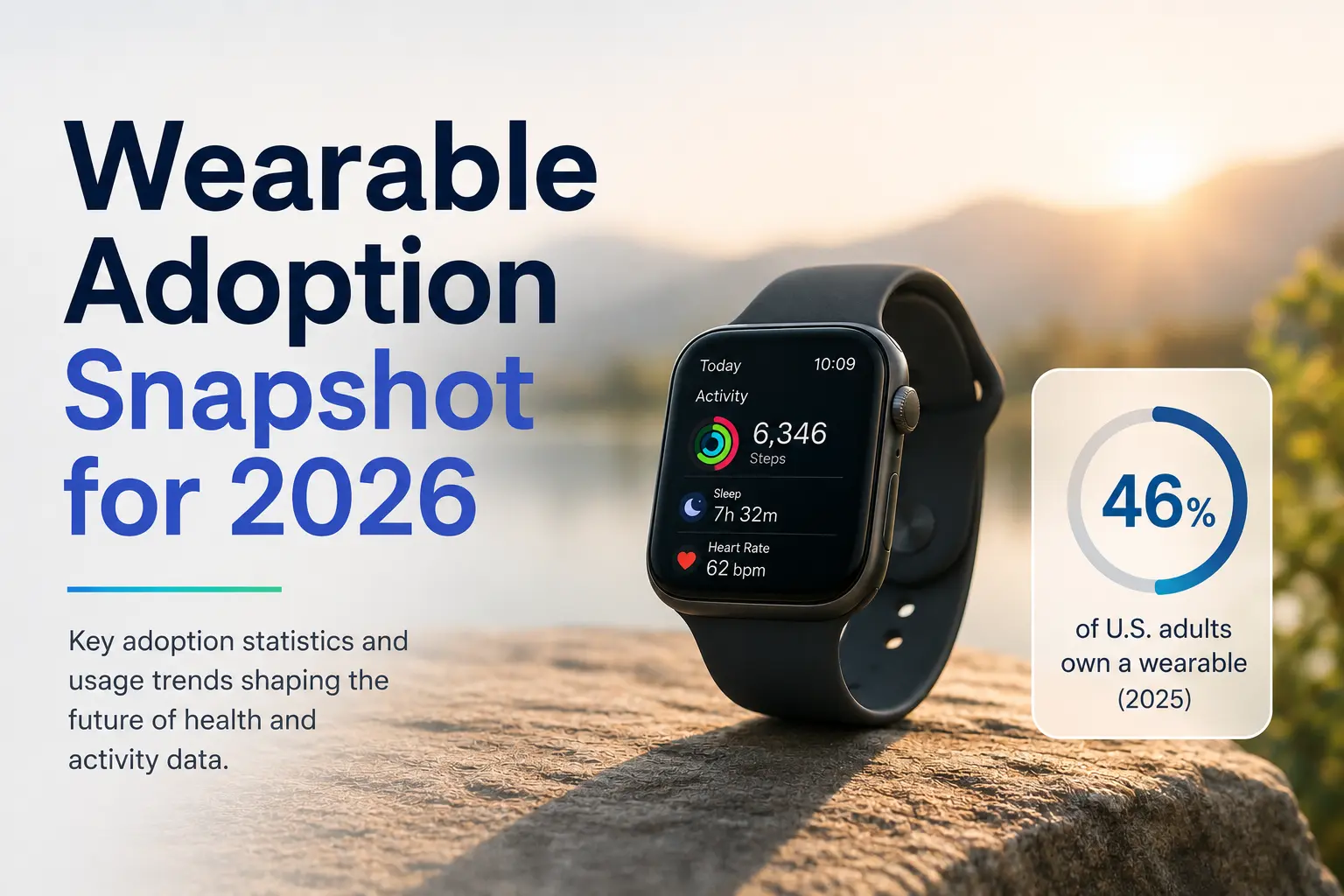
The global wearable technology market was valued at $92.9 billion in 2025 and is projected to more than double by 2033. Research also links consistent wearable use to measurable increases in daily activity while giving clinicians and coaches a clearer view of the people they support.
What people are actually wearing
Smartwatches still lead by a wide margin, however, blood pressure and glucose monitors show the category has expanded well outside fitness trackers.
| Device type | US adult ownership |
|---|---|
| Smartwatch | 43% |
| Smart scale | 13% |
| Connected blood pressure cuff | 13% |
| Continuous glucose monitor | 9% |
| Smart ring | 8% |
Does wearing a wearable actually change your health
The research is more nuanced than marketing copy suggests, but you can see a clear pattern. A systematic review of systematic reviews (yes, that's real) covering dozens of trials found activity trackers raised step counts by an average of 1,127 steps per day at four to six months, with smaller but lasting effects still visible up to four years later. A separate review from the University of South Australia, spanning almost 400 studies and 164,000 participants, found trackers added up to 40 extra minutes of walking a day and produced an average 1 kg weight loss over five months.
Sleep tracking tells a similar story of a real yet modest impact. A survey of wearable users conducted over seven years found people report bigger improvements in physical activity than in sleep or diet. Sharing data from health and fitness apps on social media has also become more common than it was a decade ago. For some users, sharing their progress publicly adds a layer of accountability that can help reinforce healthy habits.
Wearables are showing up in clinical and coaching settings too
The shift isn't only personal. In a 2026 survey of 2,222 physicians from across the world, 97% said they review wearable data from patients in some capacity and that confidence in its clinical value is high. What's holding back deeper adoption isn't a lack of interest from the physicians. Not a single country surveyed reported integration rates above 6% largely due to reimbursement rules and workflow gaps and not because of any skepticism over data quality.
On the patient side, a 2025 study found that 78.4% of wearable users were willing to share wearable information with a health-care provider. That said, a disconnect clearly exists as only 26.5% had actually done so during the previous year.
The real challenge is no longer collecting the data
As wearable adoption grows, the challenge is shifting from collecting data to making sense of information spread across different devices and platforms. One person might track their regular activity with an Apple Watch, sleep with an Oura Ring and wear a Garmin for workouts. Another client may use MyFitnessPal for meal tracking and Strava for recording distance running. A coach managing a full roster can end up switching between several dashboards just to understand what is happening across the team. Clinics encounter it too, since patient-generated data is only useful when it can fit into an existing workflow.
Solving that problem requires something different from the wearable itself. The device collects the data. A health analytics platform can bring data from multiple sources into one place, making it easier for staff to spot changes, analyze trends and avoid checking each app individually. Platforms such as Sonar Atlas take this approach by connecting app and wearable data in one place. The value is not simply having more metrics on a screen. It is making the data easier to interpret and use when a decision needs to be made.
About Sonar
Your body is talking. Are you listening? Sonar unifies all of your wearables, lifestyle, and biomarker data to unlock personalized insights and detection once reserved for elite athletes and biohackers. Trusted by 250,000+ users across 170+ countries, Sonar helps you cut through the noise across sleep, recovery, stress, activity, and nutrition - so you can focus on what actually matters. Sonar isn't just another health tracker. Launched out of Columbia University in New York, it merges the latest medical, sports and data science with AI engines that continuously surface subtle shifts and patterns across millions of data points, helping you know when to push, when to pause, and where to focus next.
More to Explore
August 19, 2026
August 14, 2026
August 12, 2026
Get the latest from Sonar
Share your email to stay up-to-date with all things Sonar
- English (Canada)
- Bahasa Indonesia
- Bahasa Melayu
- Català
- Čeština
- Dansk
- Deutsch
- English
- English (Australia)
- English (UK)
- Español (España)
- Español (Latinoamérica)
- Español (México)
- Français
- Français (Canada)
- Hrvatski
- Italiano
- Magyar
- Nederlands
- Norsk
- Polski
- Português (Brasil)
- Português (Portugal)
- Română
- Slovenčina
- Slovenščina
- Suomi
- Svenska
- Tiếng Việt
- Türkçe
- Ελληνικά
- Русский
- Українська
- עברית
- العربية
- हिन्दी
- ไทย
- 한국어
- 日本語
- 简体中文
- 繁體中文
EN