
How Coaches Use a Wearable Data Platform to Improve Client Health and Performance
Quick answer
A wearable data platform for coaches makes that data more useful by connecting fitness metrics such as cardio load and HRV with health signals like sleep, nutrition and recovery. Lab records can also be brought into the equation providing a holistic view of each client's performance. The value comes from identifying meaningful changes over time rather than reacting to one score on one device.
Most of your clients already wear something on their wrist or finger. The American College of Sports Medicine ranked wearable technology as the number one fitness trend for 2026, and stated that nearly half of U.S. adults now own a fitness tracker or smartwatch. Our wearable adoption snapshot breaks down who is wearing what. The harder question for coaches is what to do with that data once clients start sharing it.
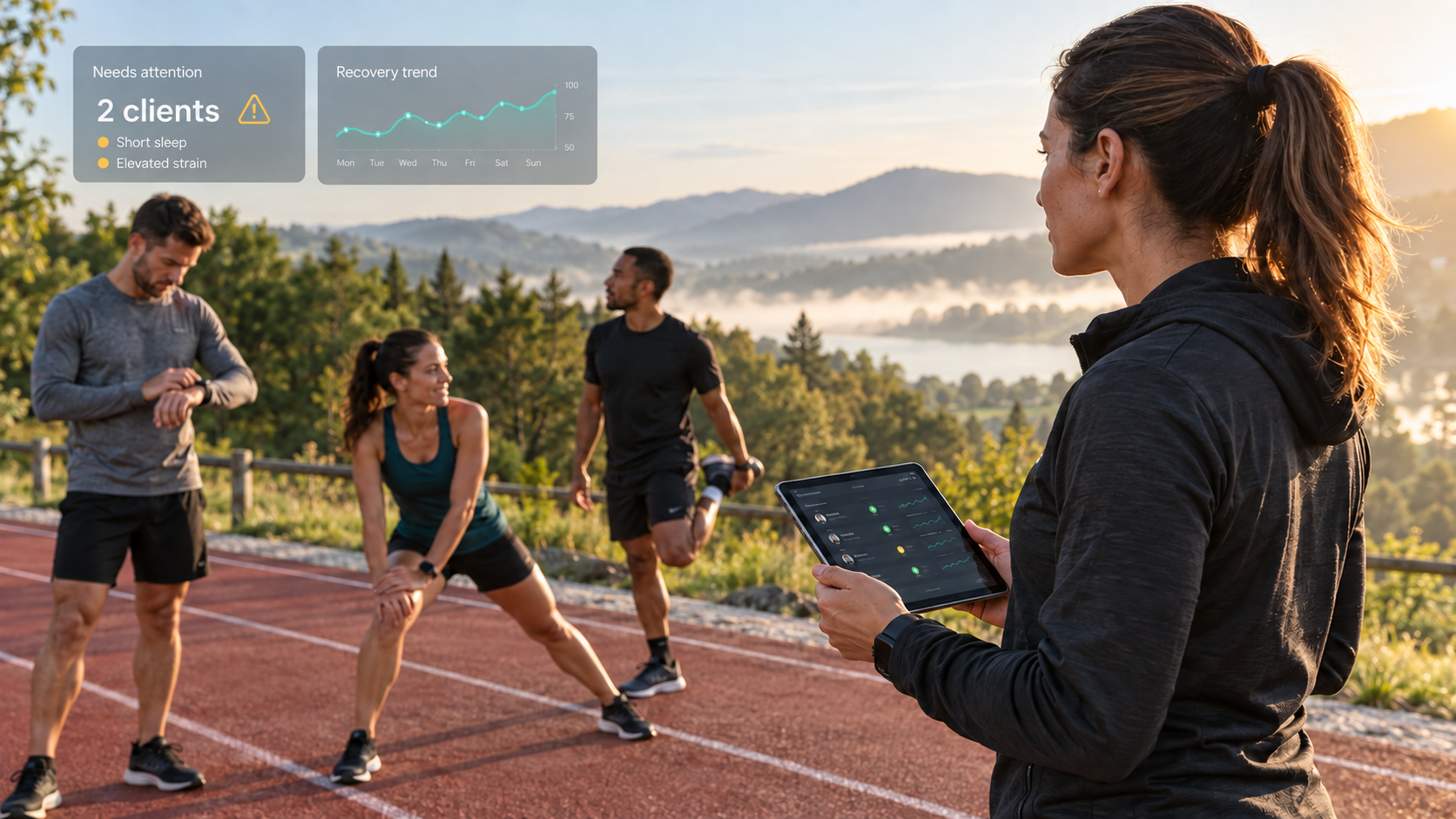
The same data serves health and fitness goals
Wearables are often discussed as performance tracking technology, but some of their strongest evidence pertains to everyday health behaviour.
A week of resting heart rate readings is more than a basic training metric. It is also a health marker. That overlap is what makes wearable data so powerful for coaches who are interested in their client's performance on and off the field (or gym).
The health side
Daily movement is one of the clearest examples. A 2025 meta-analysis in The Lancet Public Health found that walking about 7,000 steps per day was associated with a 47% lower risk of all-cause mortality compared with 2,000 steps. The researchers also found a lower risk of cardiovascular disease and dementia at that level.
For coaches, this widens the purpose of wearable monitoring. A trainer working with a general fitness client might focus on strength progress in the gym, but how much that client moves the rest of the day matters too. If their daily activity climbs while their training plan stays the same, that's a sign the programme is shaping habits well beyond the scheduled session. Coaches can use this data point to demonstrate the value of their services.
Cardiorespiratory fitness carries even more weight. In a Cleveland Clinic study of 122,007 adults, people in the lowest fitness group had roughly five times the mortality risk of elite performers. The authors found that low fitness carried a risk comparable to or greater than smoking or diabetes. Many modern watches now estimate VO2 max, giving coaches a directional trend line for a number that once required a lab test.
The fitness side
On the performance side, wearables help coaches individualise training load. A 2021 meta-analysis in the Journal of Science and Medicine in Sport found that endurance training guided by wearable HRV data had a moderately positive effect on submaximal physiological markers compared to fixed plans. Fewer athletes saw their performance decline when training was adjusted according to daily HRV outputs.
As you'd expect, sleep connects with both sides. A study in the Journal of Pediatric Orthopaedics found adolescent athletes who slept less than 8 hours a night were 1.7 times more likely to be injured than those who slept 8 hours or more. This demonstrates how sleep is not only a recovery input but also a health outcome. If you want to better understand the stage that drives physical repair, see what deep sleep is and why it matters.
Wearable data becomes more valuable when metrics are connected
Today's wearables are purposefully designed around the individual. A smartwatch might track workouts whereas a smartring measures overnight recovery. A separate app may be used for logging meals and sourcing nutritional data.
For a coach managing multiple clients or an entire team, opening each ecosystem individually is time consuming and does not scale. More importantly, looking at metrics in a silo can remove the valuable context needed to interpret them.
Say an athlete's HRV drops for several days in a row. That alone doesn't tell you much. But if their sleep has also been shorter while training volume remains constant, you're given a more concrete lead to investigate. If the training volume happens to jump at the same time, you're presented with an entirely separate issue to pursue.
This is why an effective athlete monitoring strategy should focus on relationships between signals rather than isolated numbers. A platform that aggregates all forms of wearable data can make those relationships easier to see at both an individual and cohort level.
How key wearable metrics map to coaching decisions
| Metric | Health signal | Fitness signal | What coaches can do with it |
|---|---|---|---|
| Daily steps | Linked to lower mortality and cardiovascular risk | Shows non-exercise activity outside sessions | Set movement targets for rest days |
| Resting heart rate | General cardiovascular marker | A sustained rise can point to fatigue or illness | Flag clients trending above their baseline |
| Heart rate variability | Reflects stress and recovery balance | Indicates readiness for hard training | Adjust intensity on low days |
| Sleep duration | Supports metabolic and mental health | Tied to injury risk and recovery | Review weekly averages instead of single nights |
| VO2 max estimate | Strong predictor of longevity | Measures aerobic capacity | Track the trend over months rather than the exact value |
| Calories burned | Useful context for weight goals | Rough guide for energy needs | Treat as an estimate only |
Coaches need trends, not more notifications
A platform becomes less useful when every minor fluctuation turns into an alert. What coaches actually need is for the patterns that could change a conversation or a decision to rise to the top.
One coach might want to know if an athlete's sleep has been slipping for a week while their workload climbs. Another might want to spot clients whose daily activity has dropped even though they're still showing up to every session. Others may want to use AI to analyse their entire roster with a simple question like "Which five athletes need the most attention right now and why?"
Those questions are much harder to answer when the data is scattered across watches, smartrings and fitness apps. Pulling it into one place also saves coaches from building spreadsheets by hand before every athlete review. Over time, that same setup can support deeper analysis through an athlete management system that ties training to recovery and overall wellbeing.
What to look for in a wearable data platform for coaches
The right platform should make your job easier and not add another dashboard to check. Look for these capabilities:
- Broad device support so clients can keep the wearables they already own
- Personal baselines that show change relative to each client instead of population averages alone
- Automated flags for meaningful shifts such as a rising resting heart rate or several short nights of sleep in a row
- Roster views that let each coach see their full group at a glance
- Clear consent, location and privacy controls because this is personal health data
Put your clients' wearable data to work
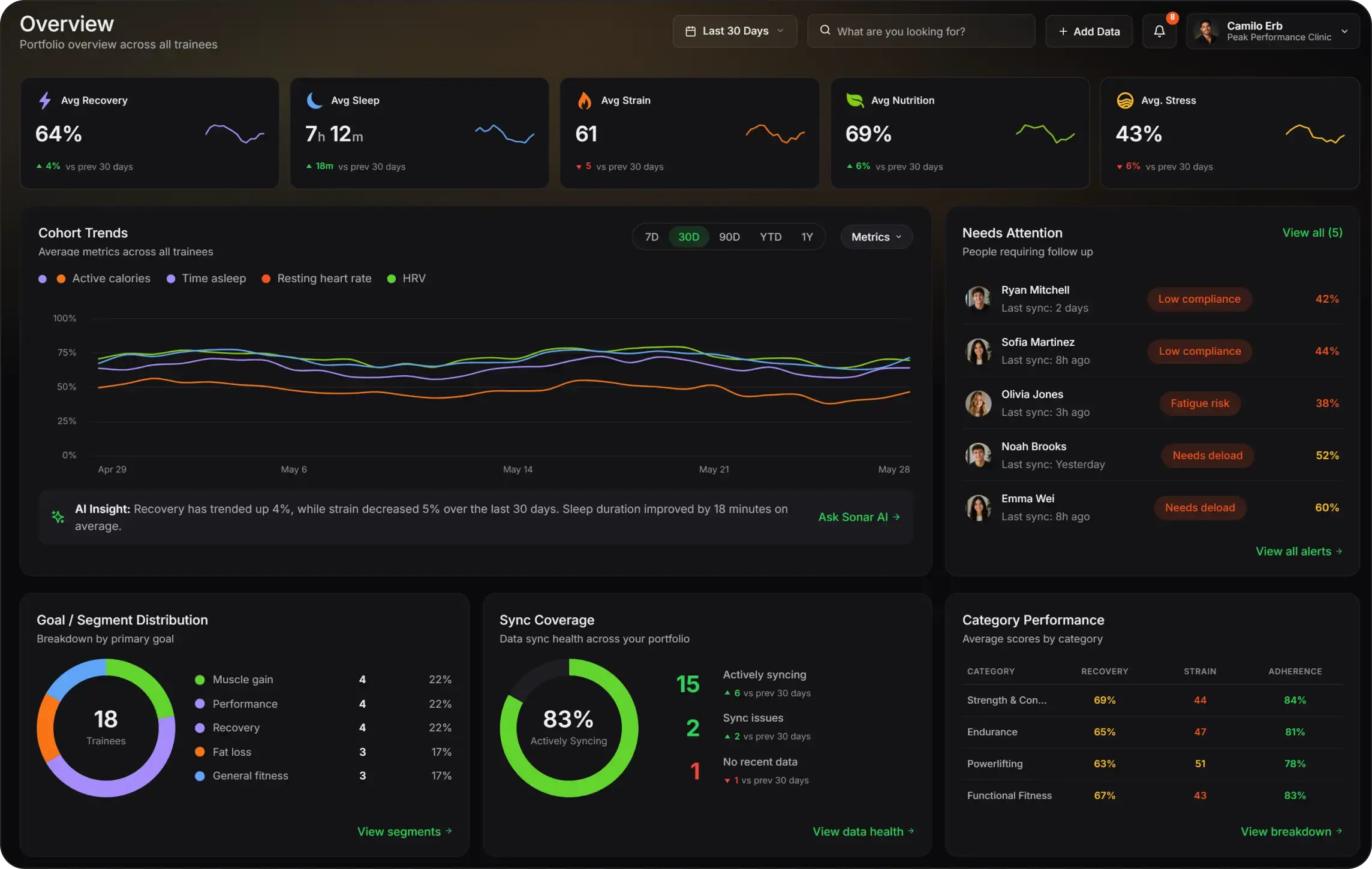
Sonar Atlas is built around exactly this checklist, syncing 600+ wearables and apps into one real-time dashboard so you can see every client's trends and know who needs attention first.
Frequently Asked Questions (FAQ)
Can coaches trust data from consumer wearables?
For many metrics, yes. Research from Stanford shows most wrist-worn devices measure heart rate with low error, especially during steady exercises like cycling. Calorie estimates are much less reliable. That said, coaches get the most value by tracking trends against each client's own baseline and treating all outputs as directional.
Which wearable metrics matter most for coaching clients?
Resting heart rate, HRV, sleep duration and daily steps provide an optimal mix of health and fitness insight. Together they show recovery performance and long-term health trends. A VO2 max estimate adds a useful long-term view of aerobic fitness.
Do all clients need the same device for a coaching platform to work?
No. A wearable data platform built for coaches should pull data from a wide range of brands and health apps. That way, clients can keep using whichever device they prefer leading to a better experience.
About Sonar
Your body is talking. Are you listening? Sonar unifies all of your wearables, lifestyle, and biomarker data to unlock personalised insights and detection once reserved for elite athletes and biohackers. Trusted by 250,000+ users across 170+ countries, Sonar helps you cut through the noise across sleep, recovery, stress, activity, and nutrition - so you can focus on what actually matters. Sonar isn't just another health tracker. Launched out of Columbia University in New York, it merges the latest medical, sports and data science with AI engines that continuously surface subtle shifts and patterns across millions of data points, helping you know when to push, when to pause, and where to focus next.
More to Explore
Get the latest from Sonar
Share your email to stay up-to-date with all things Sonar
- English (UK)
- Bahasa Indonesia
- Bahasa Melayu
- Català
- Čeština
- Dansk
- Deutsch
- English
- English (Australia)
- English (Canada)
- Español (España)
- Español (Latinoamérica)
- Español (México)
- Français
- Français (Canada)
- Hrvatski
- Italiano
- Magyar
- Nederlands
- Norsk
- Polski
- Português (Brasil)
- Português (Portugal)
- Română
- Slovenčina
- Slovenščina
- Suomi
- Svenska
- Tiếng Việt
- Türkçe
- Ελληνικά
- Русский
- Українська
- עברית
- العربية
- हिन्दी
- ไทย
- 한국어
- 日本語
- 简体中文
- 繁體中文
EN