
What Is Athlete Monitoring? How Training Load and Recovery Tracking Works
Quick answer
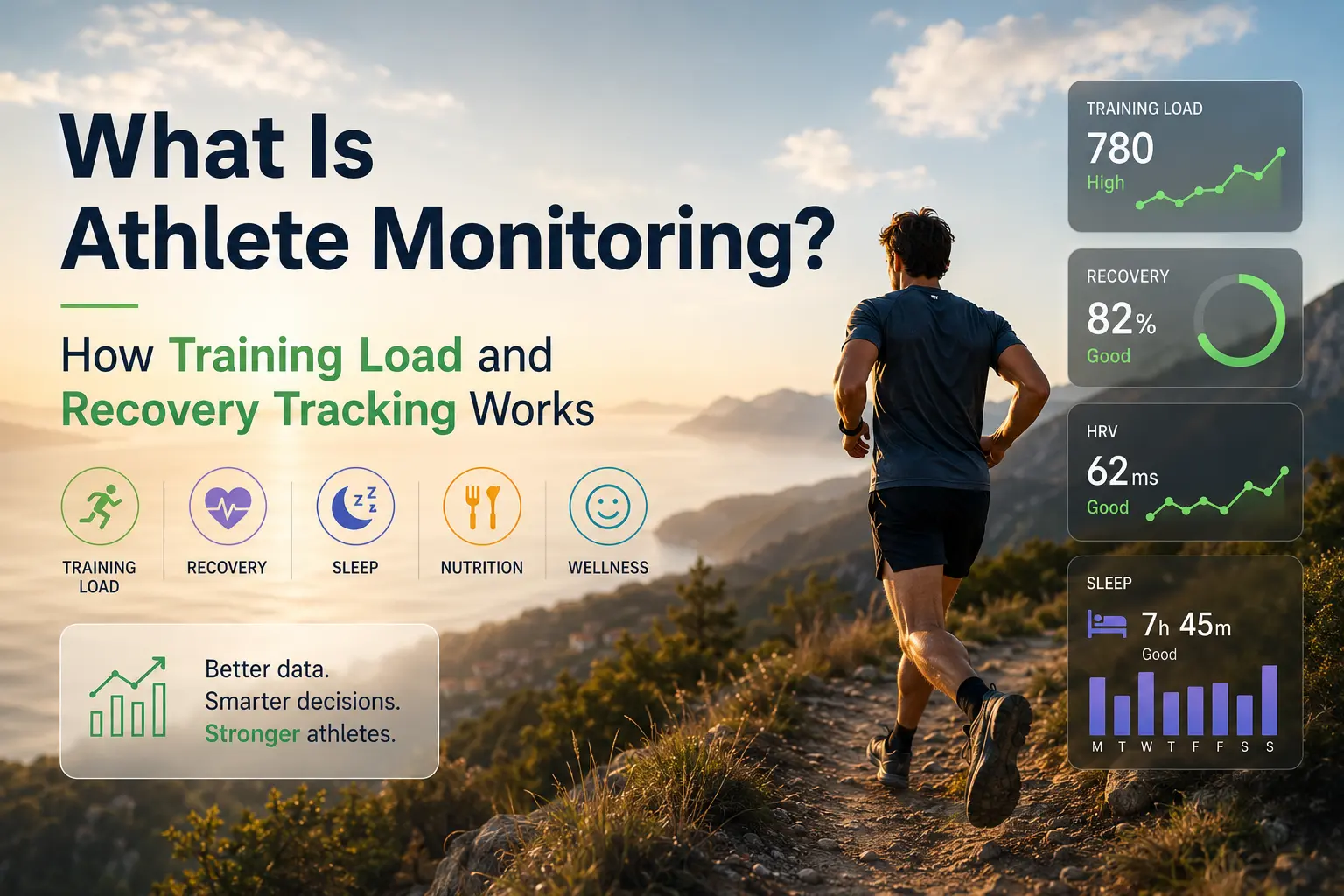
Athlete monitoring is the ongoing practice of tracking performance data like training load or recovery over time so coaches can ascertain the readiness of an athlete and reduce the risk of overreaching or injury. It pairs external measures like workout type and distance with internal signals like heart rate, stress, nutrition and HRV.
There isn't one metric that tells the full story. Most established systems combine a handful of objective and subjective measures and look at trends across weeks rather than reacting to any single reading.
What is athlete monitoring?
Athlete monitoring refers to the systematic tracking of training stress, physical response and recovery status over time. The goal is fairly simple even when the methods aren't: figure out how much load an athlete can handle, notice when that load is becoming too much and adjust before performance drops or an injury shows up.
Athlete monitoring became increasingly formalised as sports scientists and coaches adopted more systematic ways to measure training load and athlete response. A 2017 consensus statement in the International Journal of Sports Physiology and Performance brought together coaches, sport scientists and medical staff to outline the practice and suggest how it can be applied.
Today athlete monitoring shows up at nearly every level of sport, from professional teams running full-time sports science departments down to individual runners logging heart rate data on a smartwatch.
What are the benefits of athlete monitoring?
Athlete monitoring can help coaches compare training sessions, identify unusual changes in athlete metrics, support more individualised conversations and evaluate how a system is working over time. It may also improve communication between coaches, athletes, sports scientists and medical staff.
These benefits depend on collecting relevant data consistently and tying it to a clear decision. More data does not automatically produce better coaching.
What athlete monitoring metrics should teams track?
There is no single set of metrics that works for every sport.
A distance runner, basketball player and weightlifter create stress in different ways. Their monitoring systems should reflect the demands of their sport and the decisions their coaches need to make. Most systems draw from the following categories.
| Category | Example metrics | What it may show | Coaching use |
|---|---|---|---|
| External training load | Distance, duration, speed, power, repetitions or accelerations | The physical work completed | Compare planned work with actual work |
| Internal training load | Session RPE, heart rate or time in heart-rate zones | How hard the work was for the athlete | Identify athletes responding differently to the same session |
| Recovery | Resting heart rate, HRV or recovery score | Changes in physiological recovery | Add context before a demanding session |
| Sleep | Duration, sleep score, wake time or REM | Whether the athlete had enough opportunity to recover | Discuss sleep habits or adjust early sessions |
| Wellness | Fatigue, soreness, stress or mood | How the athlete feels physically and mentally | Start a conversation before problems become more disruptive |
| Nutrition | Calories, carbohydrate intake, protein intake, fluid intake or body mass changes | Whether the athlete is adequately fuelling training and replacing fluids | Adjust fuelling plans, recovery meals or hydration strategies |
Athlete monitoring tools and methods explained
Session RPE
Session RPE is one of the simplest and most widely used internal load methods. It asks an athlete to rate how hard a session felt using Foster's modified CR10 scale (0–10) roughly 30 minutes after finishing. A review of the method's validity found it correlates well with more complex heart rate based measures while requiring no wearables or peripherals at all.
Heart rate variability (HRV)
HRV measures variation in the time between heartbeats and is commonly used as one indicator of cardiac autonomic activity. It can be influenced by training, sleep, illness, psychological stress and measurement conditions. A 2025 narrative review recommended routine measurements under consistent conditions, with weekly averages and variability reviewed instead of judging recovery from one isolated reading.
Acute:chronic workload ratio (ACWR)
ACWR compares an athlete's training load over the past week (acute) to their average load over the past four weeks (chronic). The idea is to flag athletes whose training has spiked well above what their body is used to. A systematic review and meta-analysis of ACWR studies found a broadly supported link between load spikes and injury risk across dozens of cohort studies, though the strength of that relationship varies by sport, methodology and dataset.
Wellness questionnaires
Short questionnaires covering sleep quality, soreness, fatigue, stress and mood remain inexpensive athlete-monitoring tools. A systematic review found that subjective measures often responded to acute and chronic training load with greater sensitivity and consistency than the objective measures included in the review. Their usefulness still depends on consistent questions, athlete trust and meaningful follow-up from staff.
Athlete monitoring apps
Athlete monitoring platforms can bring wearable, training and self-report data into one view, reducing the need to review each device or app separately. In a 2022 survey of 30 UK elite-sport practitioners, 83% reported using an athlete monitoring system, with athlete self-report measures among the most common inputs. The study also found that feedback to athletes was often limited, showing that data collection only adds value when the information is reviewed and communicated.
A centralised athlete monitoring platform can be particularly useful when athletes across a roster use different devices or data sources.
How athlete monitoring platforms work in practice
Most modern systems follow a similar sequence.
Establish a baseline
Collect data under consistent conditions long enough to characterise the athlete's normal range. The appropriate period depends on the metric, training phase and frequency of measurement.
Track consistently
Decide when each metric will be collected and use the same method whenever possible. Inconsistent timing, devices or questionnaire wording can make trends harder to interpret.
Set individual flags
When alerts are used, base them on the athlete's own history and review them alongside team context. A flag should begin a review rather than automatically change training.
Combine objective and subjective signals
No single metric is reliable enough on its own, so coaches typically combine HRV and training load with daily wellness scores before making a call.
Review at useful intervals
Review data at the cadence required by the decision. Daily checks may support immediate follow-up, while weekly and training-block reviews can help evaluate broader adaptation.
How to interpret athlete monitoring data with AI
Reviewing several data streams manually takes time, which is part of why AI assistants have become an increasingly more common tool for assessing athlete's vitals. An AI tool is more adept at spotting trends across metrics than someone scanning several dashboards for it. Knowing the right prompts and queries can help answer essential questions regarding athlete performance.
What changed? AI tools are good at comparing this week's numbers against a rolling baseline and summarising which metrics moved.
Is the change outside the athlete's normal range? This depends on individual baselines, so a prompt is only as useful as the history behind it.
What other data supports or contradicts it? Cross-referencing sleep, HRV, soreness and training load together is exactly the kind of pattern-matching AI handles well.
What action is appropriate today? AI can see the complete picture of each athlete and put forward hyper-personalised recommendations.
A few example prompts to query:
"Look at Aaron's sleep duration, HRV and recovery score for the past 14 days. What changed in the last four days compared to the ten days prior?"
"Build a half marathon training plan for Ashley using her recent activity log, sleep score, nutrition and recovery."
"Which athletes have recovery scores outside their normal ranges?"
Limitations to keep in mind
Athlete monitoring is useful, but it isn't foolproof. A few limitations come up often in the research.
No single metric tells the whole story. The IJSPP consensus statement stresses that training load markers should be combined and interpreted by qualified staff rather than treated as automatic red or green lights.
ACWR thresholds are inconsistent across studies. A review of professional football research found the relationship between ACWR and injury risk still varies by method and sport, so exact cutoffs shouldn't be applied too rigidly.
Individual variability is large. What counts as a concerning HRV drop or a high soreness score for one athlete may be completely normal for another, which is why baselines matter more than population averages.
Compliance affects data quality. Monitoring only works if athletes fill out questionnaires and wear devices consistently. Missing data can quietly skew a trend line.
Frequently Asked Questions (FAQ)
What are the best metrics for athlete monitoring?
Useful starting metrics include session duration, session RPE, sleep duration, stress, fatigue and training readiness. Heart rate, HRV and cardio load can add more context when they are relevant to the sport.
What is the difference between internal and external load?
External load is the physical work performed, measured by things like distance or sprint count. Internal load is how the athlete's body responds to that work, measured through heart rate, perceived exertion or lab testing.
What is a good acute:chronic workload ratio?
There is no universally valid "good" acute:chronic workload ratio. Oft-cited ranges such as 0.8-1.3 or thresholds above 1.5 came from specific datasets and should not be applied to every athlete or sport. Calculation method, training history and context can materially change the result. ACWR is best treated as one descriptive workload measure rather than a strict cutoff.
Is wearable data accurate enough for athlete monitoring?
Accuracy depends on the device and metric. Many wearables are useful for tracking repeated trends, but sleep stages, calorie estimates and proprietary readiness scores should not be treated as clinical measurements. Use the same device and collection method consistently, then interpret the data alongside athlete feedback, training history and coaching context.
About Sonar
Your body is talking. Are you listening? Sonar unifies all of your wearables, lifestyle, and biomarker data to unlock personalised insights and detection once reserved for elite athletes and biohackers. Trusted by 250,000+ users across 170+ countries, Sonar helps you cut through the noise across sleep, recovery, stress, activity, and nutrition - so you can focus on what actually matters. Sonar isn't just another health tracker. Launched out of Columbia University in New York, it merges the latest medical, sports and data science with AI engines that continuously surface subtle shifts and patterns across millions of data points, helping you know when to push, when to pause, and where to focus next.
More to Explore
Get the latest from Sonar
Share your email to stay up-to-date with all things Sonar
- English (UK)
- Bahasa Indonesia
- Bahasa Melayu
- Català
- Čeština
- Dansk
- Deutsch
- English
- English (Australia)
- English (Canada)
- Español (España)
- Español (Latinoamérica)
- Español (México)
- Français
- Français (Canada)
- Hrvatski
- Italiano
- Magyar
- Nederlands
- Norsk
- Polski
- Português (Brasil)
- Português (Portugal)
- Română
- Slovenčina
- Slovenščina
- Suomi
- Svenska
- Tiếng Việt
- Türkçe
- Ελληνικά
- Русский
- Українська
- עברית
- العربية
- हिन्दी
- ไทย
- 한국어
- 日本語
- 简体中文
- 繁體中文
EN