
Garmin CIRQA vs Fitbit Air: Which Screenless Fitness Tracker Is Better?
Quick answer
The Garmin CIRQA is the better screenless fitness tracker for athletes and serious Garmin users seeking a different form factor. It offers deeper training metrics, up to 10 days of battery life and access to most health and recovery insights without a required subscription. It also supports more than 80 sports and activities, connected GPS and heart rate broadcasting.
The Fitbit Air is the better option for casual health tracking at a solid price point. It costs $99.99, weighs just 12 grams with its band and tracks heart rate, sleep, SpO2 and skin temperature. It also can detect irregular rhythms which can signal possible signs of atrial fibrillation. The main drawback is that Google Health Premium is needed for features such as adaptive fitness plans and proactive insights.
For most athletes, Garmin CIRQA wins. For someone who wants a smaller and affordable tracker, Fitbit Air offers better upfront value.
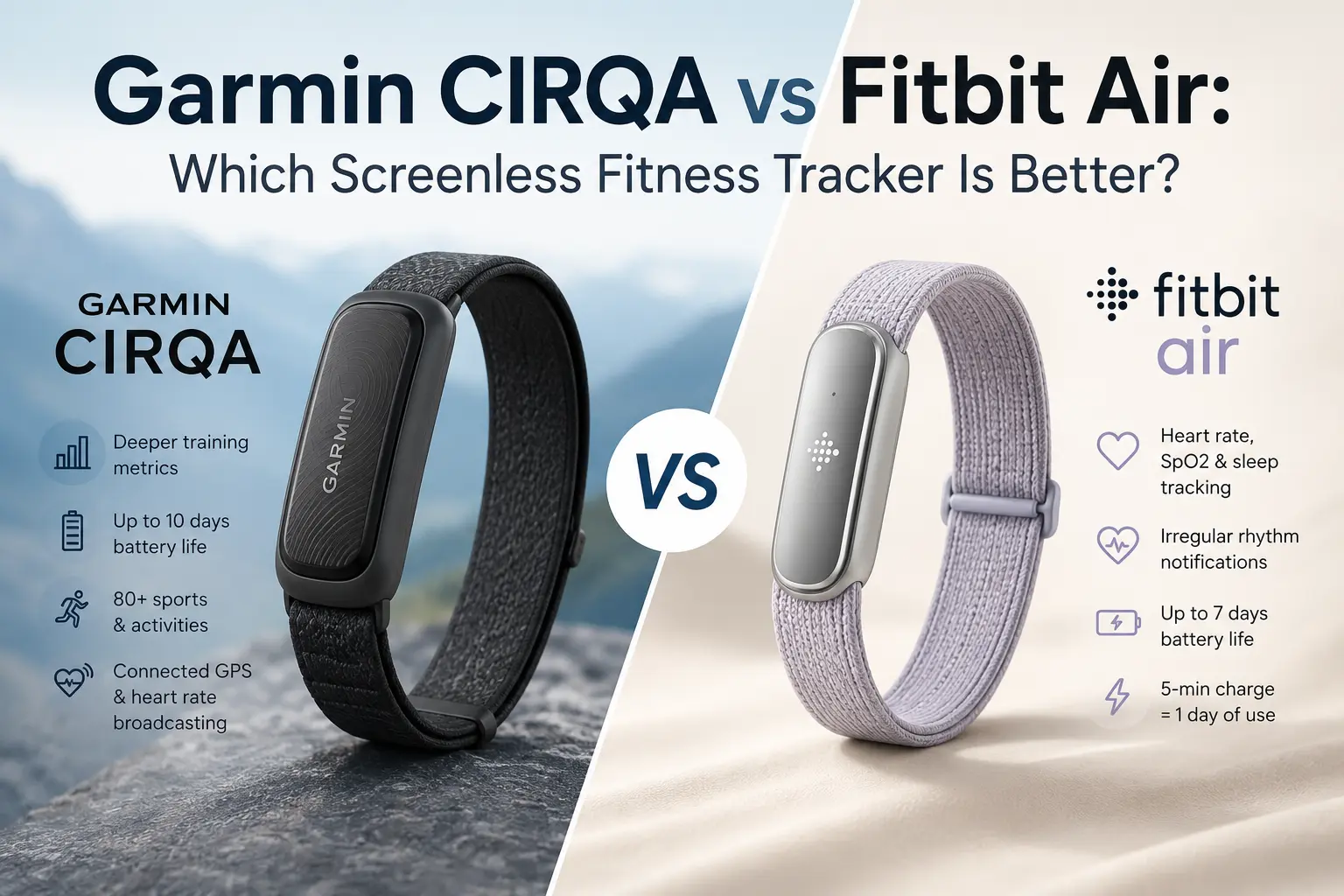
Compare the specs
| Feature | Garmin CIRQA | Fitbit Air |
|---|---|---|
| Price | $199.99 | $99.99 |
| Screen | None | None |
| Companion app | Garmin Connect | Google Health |
| Optional subscription | Garmin Connect+, $6.99 per month | Google Health Premium, $9.99 per month after a three-month trial |
| Battery life | Up to 10 days | Up to 7 days |
| Quick charging | No advertised fast-charge feature | Yes, a five-minute charge can provide one day of use |
| Module weight | 14.8 grams | 5.2 grams |
| Built-in GPS | No, connected GPS only | No, connected GPS only |
| Water resistance | 5 ATM | Water resistant to 50 metres |
| Band width | 27 mm | 18 mm with Performance Loop |
| Platform support | iOS and Android | iOS 16.4 or later and Android 11 or later |
| Release date | July 21, 2026 | May 26, 2026 |
Battery life and charging
The Cirqa's screen-free design helps it stretch to about 10 days on a full charge. The Fitbit Air lands closer to 7 days but packs a 5 minute fast charge that restores a full day of battery life, which matters if you're someone who forgets to charge overnight.
Price and subscription
The Fitbit Air is the cheaper device by a wide margin at a price of $99.99. Google throws in a three month trial of Google Health Premium, which unlocks the Gemini-powered coaching features. After the trial, Premium runs about $9.99 a month or $99 a year.
The Cirqa costs twice as much at $199.99 and doesn't require a subscription to use its core health tracking features. Garmin does offer the Connect+ tier at $6.99 a month or $69.99 a year for deeper training insights, similar to how Google Health Premium layers on top of the free tier.
Design and comfort
The Fitbit Air uses a rounded pebble design that snaps into accessorized bands. It weighs about 12 grams and uses an 18mm band, which can be noticeably more narrow than the Cirqa's 27mm strap.
The Cirqa has a fabric strap and quick release pins that let it switch between a wrist band and an upper arm band depending on your preference. It contains a button with numerous functions such as starting a workout or pairing devices. It ships in two sizes and four colours with three additional colours available on the replacement bands.
Both trackers are rated for swimming and showering. The Cirqa carries a 5 ATM rating while the Fitbit Air is rated to 50 metres, which covers roughly the same depth in practice.
Health and fitness tracking features
Both devices track the fundamentals throughout your day and night: heart rate, blood oxygen and sleep. Beyond that, the two brands lean into their own strengths.
The Cirqa carries over most of what you'd find on a mainstream Garmin watch, including Body Battery energy tracking, stress monitoring, sleep reports and cycle tracking. A glaring omission is ECG due to having a different optical sensor, as DC Rainmaker explains (read that review). The Fitbit Air does include irregular rhythm notifications as a standard feature.
Neither tracker has built-in GPS. They can use a paired phone to record location, distance and pace during outdoor workouts.
| Feature | Garmin CIRQA | Fitbit Air |
|---|---|---|
| Heart rate | Yes, monitored continuously | Yes, monitored continuously |
| SpO2 | Yes | Yes |
| Skin temperature | Yes, measured at night | Yes, measured at night |
| HRV | Yes | Yes |
| Sleep stages | Yes | Yes |
| Nap detection | Yes | Yes |
| AFib monitoring | No | Irregular rhythm notifications |
| Cardio load tracking | Yes | Yes |
| Cycle tracking | Yes | Yes |
| Calorie tracking | Yes | Yes |
| Stress tracking | Yes | Yes, through Resilience Score and related insights |
| Smart wake alarm | Yes | Yes |
| Recovery insights | Training Readiness and Body Battery | Daily Readiness |
Which tracker is better for your use case?
Both devices track the fundamentals around the clock: heart rate, blood oxygen and sleep. Beyond that, the two brands are built for different kinds of users.
Serious Trainers
Garmin Cirqa is the better choice for anyone following a training plan. It supports more than 80 sports and activities and includes metrics such as Training Readiness, training effect, HRV, SpO2, recovery time and acute load. It can also broadcast live heart rate to compatible devices.
Casual fitness trackers
Fitbit Air is built for simpler activity tracking. It automatically detects common workouts and uses connected GPS for runs, walks, hikes and bike rides. It suits someone who wants casual health tracking without the learning curve of a full training platform, though Garmin offers more depth for runners and cyclists.
Subscription haters
Garmin CIRQA is the better choice if you want advanced insights without a monthly fee. Features such as Training Readiness, Body Battery, detailed sleep tracking and recovery time are included through Garmin Connect. Fitbit Air does cover core tracking features without a subscription, but they do not pack as much of a punch.
Heart health monitors
Fitbit Air tracks your heart rhythm and looks out for signs of AFib. The Cirqa does not include this functionality.
Frequently Asked Questions (FAQ)
Does the Garmin CIRQA or Fitbit Air have GPS?
Neither tracker has built-in GPS. Both can use a paired phone's GPS to record routes, distance and pace during supported outdoor activities.
Can you swim with the Garmin CIRQA and Fitbit Air?
Yes. Garmin CIRQA has a 5 ATM water rating, which means it withstands pressure equivalent to a depth of 50 metres. Fitbit Air is also rated as water resistant to 50 metres. Both companies recommend drying the tracker and band after they become wet.
How long does each tracker's battery last?
The Cirqa lasts up to 10 days per charge. A full charge can take up to 90 minutes. The Fitbit Air lasts up to 7 days but includes a 5 minute fast charge that adds a full day of use. A full charge is also around 90 minutes.
Do Garmin Cirqa and Fitbit Air require a subscription?
No. Both trackers work for daily health and fitness tracking without needing to pay. Garmin Connect+ and Google Health Premium are optional upgrades that add deeper coaching and training insights on top of the free tier.
About Sonar
Your body is talking. Are you listening? Sonar unifies all of your wearables, lifestyle, and biomarker data to unlock personalised insights and detection once reserved for elite athletes and biohackers. Trusted by 250,000+ users across 170+ countries, Sonar helps you cut through the noise across sleep, recovery, stress, activity, and nutrition - so you can focus on what actually matters. Sonar isn't just another health tracker. Launched out of Columbia University in New York, it merges the latest medical, sports and data science with AI engines that continuously surface subtle shifts and patterns across millions of data points, helping you know when to push, when to pause, and where to focus next.
More to Explore
17 July 2026
13 July 2026
Get the latest from Sonar
Share your email to stay up-to-date with all things Sonar
- English (UK)
- Bahasa Indonesia
- Bahasa Melayu
- Català
- Čeština
- Dansk
- Deutsch
- English
- English (Australia)
- English (Canada)
- Español (España)
- Español (Latinoamérica)
- Español (México)
- Français
- Français (Canada)
- Hrvatski
- Italiano
- Magyar
- Nederlands
- Norsk
- Polski
- Português (Brasil)
- Português (Portugal)
- Română
- Slovenčina
- Slovenščina
- Suomi
- Svenska
- Tiếng Việt
- Türkçe
- Ελληνικά
- Русский
- Українська
- עברית
- العربية
- हिन्दी
- ไทย
- 한국어
- 日本語
- 简体中文
- 繁體中文
EN