
What Is Body Battery? How Garmin’s Energy Score Works
Quick Answer
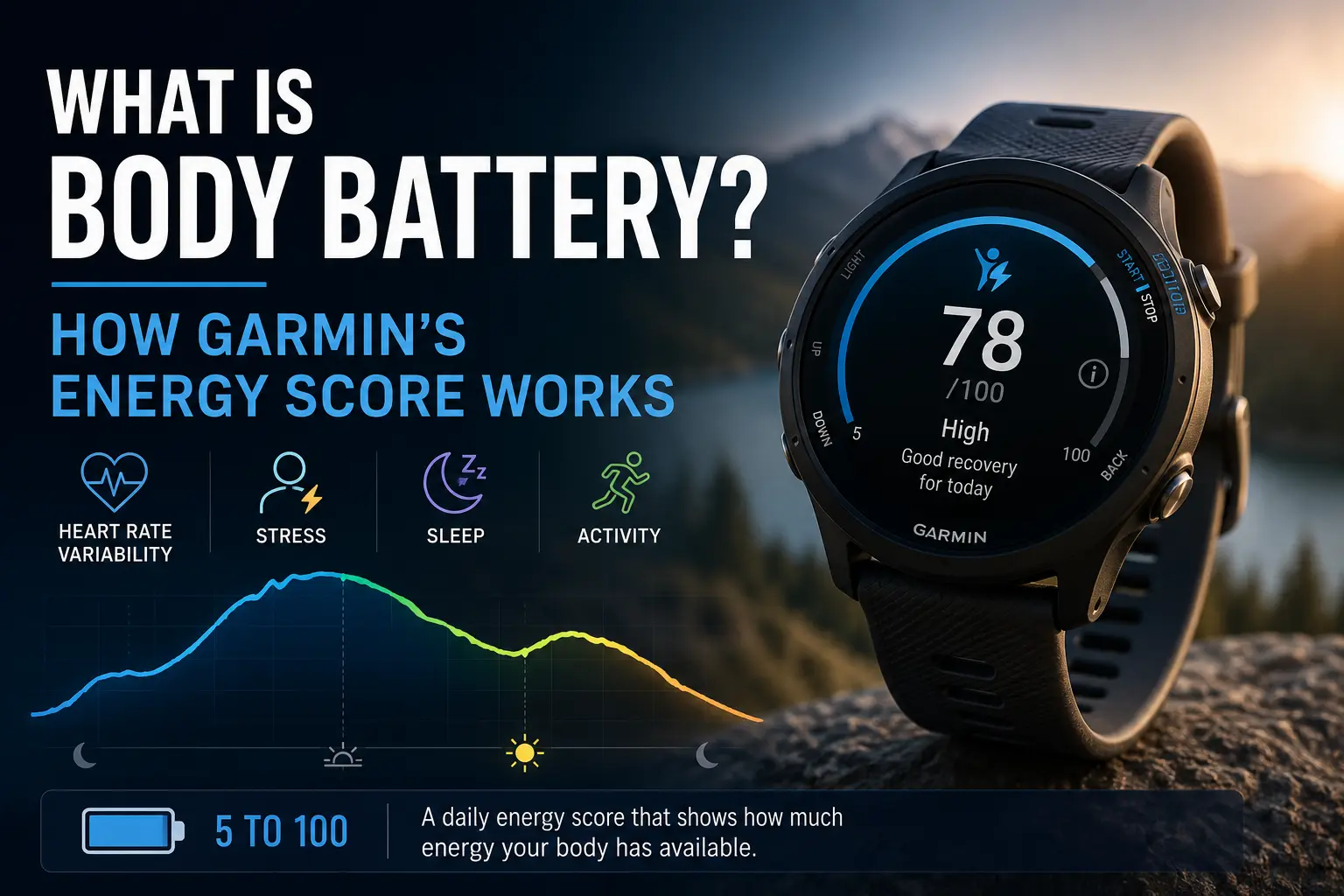
Body Battery is Garmin’s daily energy score, measured from 5 to 100, that uses heart rate variability, stress, sleep and activity data to estimate how much energy your body has available.
A higher score usually means your body is more recovered and ready for effort. A lower score means your body may need rest, lighter activity or better recovery. Garmin describes Body Battery as a way to monitor your personal energy resources throughout the day.
What Is Body Battery?
Body Battery is a health metric from Garmin that works like a fuel gauge for your body. The number typically moves up during the night as you sleep and down during the day as you exert yourself. Body Battery uses heart rate variability, stress and activity levels to estimate your energy reserves. The score is shown from 5 to 100.
Body Battery scores at a glance
| Body Battery Score | What It Usually Means | How To Use It |
|---|---|---|
| 76 to 100 | High energy and strong recovery | Good time for hard training or demanding work |
| 51 to 75 | Moderate energy | Normal daily activity should feel manageable |
| 26 to 50 | Low energy | Consider lighter exercise or more recovery |
| 5 to 25 | Very low energy | Prioritize rest, sleep and stress management |
These ranges are general guidelines rather than hard rules. Someone who trains consistently might function fine at a lower number than someone who rarely exercises, since the body adapts over time. The best way to use it is to compare it with how you actually feel. Your score also doesn’t need to hit 100 every morning. In fact, plenty of Garmin users report seldom seeing a perfect score at all.
What Drains and Recharges Your Body Battery?
Your Body Battery can drop for obvious reasons like a hard workout, a whirlwind travel day or a rough night of sleep. It also reacts to things you might not expect. For example, a routine moment like driving a car can act as a meaningful stressor, with the effect varying significantly from person to person.
Common reasons you’ll see a lower score:
- Physical activity, whether it’s a workout or just a demanding day on your feet
- Mental and emotional stress, even from things that feel positive like going to a concert
- Poor or inadequate sleep
- Alcohol, which Garmin specifically calls out as one of the bigger disruptors since metabolizing it raises stress and hurts sleep quality
- Illness, which triggers an immune response that shows up as elevated stress before you even feel sick
Sleep and peaceful recovery moments are what actually replenish the battery, while activity and stress pull it back down no matter how light the activity is. Garmin has also noted that food intake and stimulants like caffeine do not directly factor into the score, so meal timing is not a confirmed driver, although it can still affect your sleep quality and how you feel overall.
The best way to actually raise your battery is to protect your sleep, keep a consistent bedtime, skip the nightcap before bed and build real downtime into your day, since even gentle movement still counts as a drain in Garmin’s model. A high score doesn’t mean you have to work out, and a low score doesn’t mean you can’t move. It’s just another signal to help you decide how hard to push.
How Accurate Is It?
Body Battery can be incredibly insightful, but it is still an estimate. It estimates your available energy from several signals rather than measuring it directly. Garmin is very upfront that its watches aren’t approved medical devices and aren’t designed to diagnose or treat anything.
There’s also some research worth keeping in mind here. A peer-reviewed study published in JMIR notes that composite scores like Body Battery rely on proprietary algorithms that aren’t public, making it harder for outside researchers to independently verify exactly how they’re calculated. So a low score might genuinely reflect stress, poor recovery or illness, but it can also come down to something as simple as a gap in your overnight data. HRV tracking is also known to get noisier when the sensor isn’t reading cleanly, often because of a loosely fitting watch band. A high score, meanwhile, is a good sign you’re well recovered, but it’s not a guarantee of peak performance on its own.
The most practical way to use Body Battery is as a daily recovery guide and long-term pattern tracker. When your score is low for several days in a row and you also feel run down, it can be a strong signal that your body needs more recovery. Like any wearable metric, though, it works best alongside your own judgment. If a number looks unusual on a given day, compare it with how you actually feel.
Other Brands Have Body Battery Type Scores Too
While many would consider Garmin to be the original, it isn’t the only company trying to answer the question of how recovered your body actually is. Most major brands have built some version of this concept into their smartwatches or apps under a different label. Sonar, for example, uses the term Energy Reserve for a real-time view of how much energy you have left in the tank. The labels differ, but the goal is mostly the same: turning sleep, stress and recovery data into a simple signal you can use throughout the day.
| Metric | Brand | What It Measures |
|---|---|---|
| Body Battery | Garmin | Overall energy reserves combining HRV, stress, sleep and activity |
| Readiness Score | Oura, Google Health | Recovery readiness based mostly on sleep and HRV trends |
| Recovery Pro | Polar | Recovery readiness based on an orthostatic HRV test and training history |
| BioCharge | Amazfit (Zepp) | Daily energy score combining sleep, naps, HRV, stress and exertion |
The easiest way to think about it is that these scores are all trying to capture the same basic idea in slightly different ways. Body Battery works well if you just want a simple, running view of your energy throughout the day. Readiness scores like Oura’s are usually better if you mainly want to know, right when you wake up, whether your body is primed for the day ahead. Recovery Pro leans more toward serious training, since it’s built specifically to estimate how long you might need before pushing hard again.
None of these numbers are meant to be the final word on their own, and that’s true no matter which one you’re using. A low score paired with a rough night of sleep and a higher than usual resting heart rate tells you a lot more than any single metric by itself.
Frequently Asked Questions (FAQ)
Does a low Body Battery mean I’m sick?
Not necessarily. A low score usually points to poor sleep, high stress or hard training rather than illness. That said, a sudden unexplained drop that sticks around for several days is worth paying attention to.
Can I increase my Body Battery during the day?
Yes. Short naps, meditation, light walking and simply relaxing can nudge the number back up, though the biggest gains come from quality sleep at night.
Why does my Body Battery drop during a workout?
Exercise is physically demanding, so the algorithm treats it as energy expenditure. The score typically rebounds afterward, especially once you recover and sleep.
Do I need a Garmin watch to track Body Battery?
The feature itself is specific to Garmin, though other brands offer comparable readiness or recovery scores using similar underlying data like HRV and sleep quality.
About Sonar
Your body is talking. Are you listening? Sonar unifies all of your wearables, lifestyle, and biomarker data to unlock personalized insights and detection once reserved for elite athletes and biohackers. Trusted by 250,000+ users across 170+ countries, Sonar helps you cut through the noise across sleep, recovery, stress, activity, and nutrition - so you can focus on what actually matters. Sonar isn't just another health tracker. Launched out of Columbia University in New York, it merges the latest medical, sports and data science with AI engines that continuously surface subtle shifts and patterns across millions of data points, helping you know when to push, when to pause, and where to focus next.
More to Explore
June 24, 2026
June 23, 2026
Get the latest from Sonar
Share your email to stay up-to-date with all things Sonar
- English
- Bahasa Indonesia
- Bahasa Melayu
- Català
- Čeština
- Dansk
- Deutsch
- English (Australia)
- English (Canada)
- English (UK)
- Español (España)
- Español (Latinoamérica)
- Español (México)
- Français
- Français (Canada)
- Hrvatski
- Italiano
- Magyar
- Nederlands
- Norsk
- Polski
- Português (Brasil)
- Português (Portugal)
- Română
- Slovenčina
- Slovenščina
- Suomi
- Svenska
- Tiếng Việt
- Türkçe
- Ελληνικά
- Русский
- Українська
- עברית
- العربية
- हिन्दी
- ไทย
- 한국어
- 日本語
- 简体中文
- 繁體中文
EN