
How to Choose the Right Fitness Tracker: 8 Things to Check Before Buying
With wearable device shipments reaching 611.5 million units globally in 2025, the market has never been more crowded. This guide explains what actually matters before you buy, including comfort, battery life, phone compatibility, workout features and subscription costs.
Quick Answer
To find the best tracker for your routine, start with your main goal: everyday health tracking, running or cycling, sleep and recovery, smartwatch features or battery life. Then compare comfort, phone compatibility, GPS accuracy, subscription costs and whether the app helps you understand your data. If you want a simple everyday tracker, look at the Fitbit Charge 6. If you are a runner, cyclist or endurance athlete, consider a Garmin Forerunner 165 or 265. If sleep and recovery matter most, the Oura Ring 4 is a strong option. If you want fitness tracking plus calls, notifications, apps and safety features, an Apple Watch SE or newer Apple Watch is usually the best fit for iPhone users. If you want a smart ring without an ongoing Oura membership and already use Samsung, the Samsung Galaxy Ring may be worth considering.
Choosing the right fitness tracker is less about buying the 'best' device and more about finding the one you will actually wear every day. A tracker can have perfect specs on paper, but if it feels bulky, needs constant charging, or gives you metrics you do not care about, it will probably end up in a drawer.
The easiest way to choose is to start with your lifestyle, not the product page. Ask yourself: Do you want something simple for steps and distance? Are you training for a race or trying to improve your workouts? Do you want notifications, calls and apps on your wrist, or would that feel distracting? Will you wear it to bed every night?
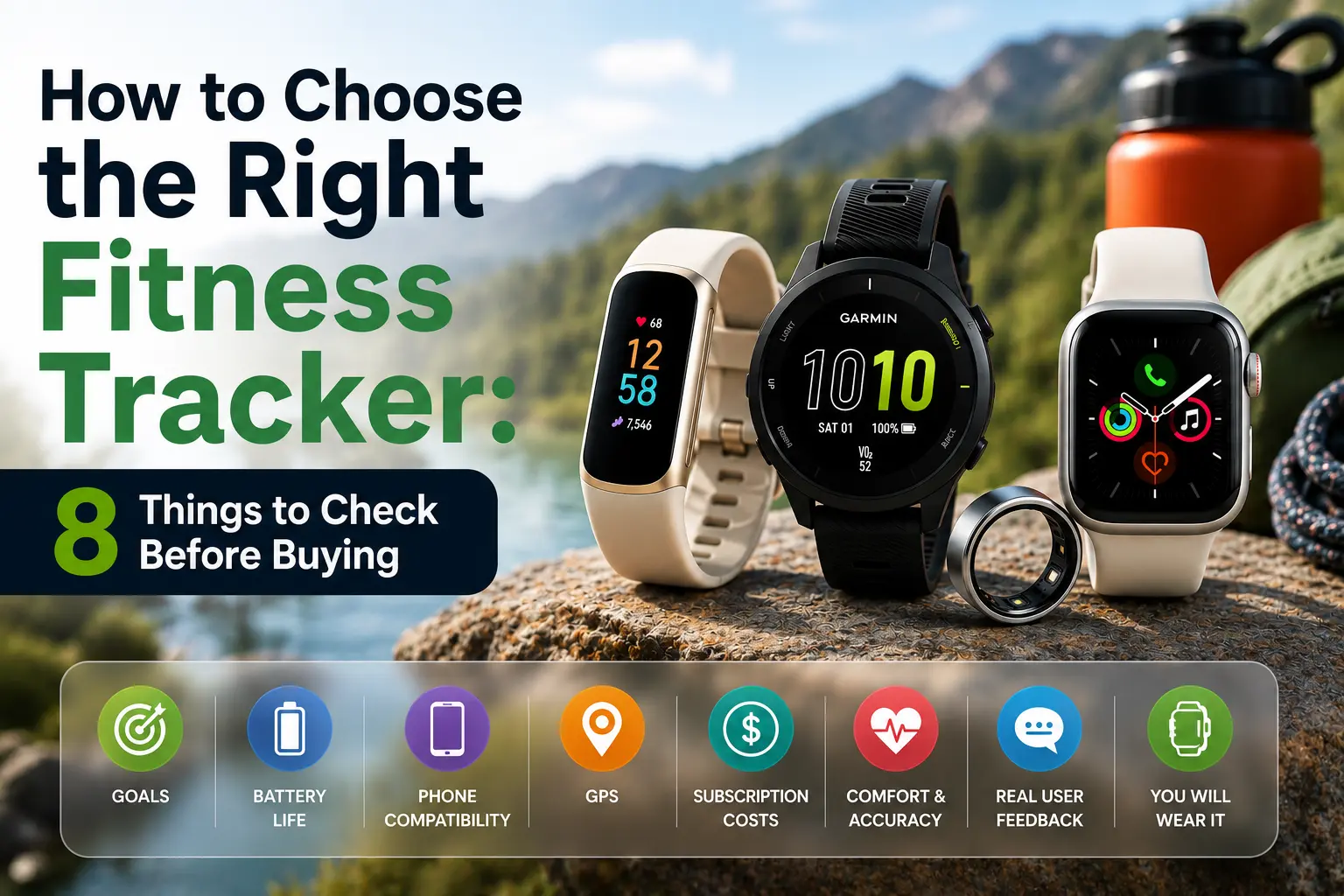
8 Things to Check Before Buying
- Pick your main goal: everyday health, sleep, running, cycling, lifting, recovery or smartwatch features.
- Choose a form factor: band, watch or ring.
- Check phone compatibility: especially if you use iPhone, Android or Samsung.
- Compare battery life: daily charging may be fine for some users but annoying for others.
- Review subscription costs: some trackers require paid memberships for full insights.
- Decide whether built-in GPS matters: important for outdoor running, cycling, and route tracking.
- Read real user feedback: comfort, durability and app reliability often matter more than spec sheets.
- Choose the tracker you will wear consistently: the best tracker is the one that fits your routine.
Fitness Tracker Comparison Table
| Product | Best For | Avoid If |
|---|---|---|
| Fitbit Charge 6 | Affordable everyday tracking | You need advanced training metrics |
| Garmin Forerunner 165 / 265 | Running, cycling, GPS and endurance training | You want a lifestyle smartwatch first |
| Oura Ring 4 | Sleep, HRV, recovery and passive health tracking | You lift heavy or want workout controls on your wrist |
| Apple Watch SE / newer Apple Watch | iPhone users who want smartwatch features and fitness tracking | You hate frequent charging |
| Samsung Galaxy Ring | Samsung users who want a smart ring without a subscription | You use iPhone or want the broadest app compatibility |
| Amazfit Band 7 | First-time buyers or users looking for affordability | You want built-in GPS or advanced training metrics |
Fitness Tracker vs. Smartwatch vs. Smart Ring
A fitness tracker is usually best for simple health metrics, longer battery life and fewer distractions. A smartwatch is better for apps, notifications, calls, safety features and deeper phone integration. A smart ring is best for passive sleep, recovery and heart rate trend tracking, but it usually offers fewer workout controls and may not be ideal for weightlifting or sports where wearing a ring is uncomfortable.
- Choose Amazfit or Fitbit if: you want simple daily health tracking at a lower price.
- Choose Garmin if: you care about running, cycling, GPS, training data, and battery life.
- Choose Oura if: sleep, readiness, recovery, and comfort matter more than workout controls.
- Choose Apple Watch if: you want fitness tracking plus apps, notifications, calls, and iPhone integration.
- Choose Samsung Galaxy Ring if: you already use Samsung devices and want a smart ring without a required subscription.
1. Decide What You Actually Want to Track
The biggest mistake most buyers make is getting drawn in by features they'll never use. Choosing the right fitness tracker starts with one question: what are you actually trying to track? A marathon runner has entirely different needs from someone who wants to sleep better or manage daily stress.
Before comparing devices, identify your primary use case. General wellness users should prioritise step accuracy and sleep-stage breakdowns. Performance athletes need GPS precision and advanced heart rate zones. Sleep and recovery-focused users should look for HRV (heart rate variability) and a daily readiness score with insight into your sleep stages.
2. Choose the Right Form Factor
As previously mentioned, fitness trackers usually come in three styles: bands, watches and rings. Bands are simple, lightweight and easy to wear all day. Watches are better if you want GPS, workout controls, notifications and a screen you can check during exercise. Rings are discreet and often more comfortable for sleep, but they are not always ideal for lifting, contact sports or workouts where you want real-time stats on your wrist.
3. Match the Tracker to Your Phone
Phone compatibility matters. Apple Watch is best for iPhone users but is not a good option for Android. Garmin, Fitbit and Oura generally work across iOS and Android, which makes them more flexible if you might switch phones later.
If you already use multiple apps or devices, think beyond the wearable itself. For example, Sonar for iOS and Android can help bring health and workout data from many sources into one place, including wearable integrations. That makes it useful if your data is spread across Apple Health, Garmin, Fitbit, Oura, Strava or other platforms.
4. Look at Battery Life Before You Buy
Battery life changes the whole experience. Apple Watch users often charge daily or every couple of days, depending on the model and use. Fitbit Charge 6 is listed by Tom's Guide as having 6 days of battery life, while Garmin watches often last longer depending on GPS settings.
If you hate charging, Garmin, Fitbit, Oura and Samsung Galaxy Ring may be a better fit than a smartwatch. If you want apps, calls and rich notifications, a shorter battery life is likely worth the tradeoff.
5. Be Realistic About Accuracy
No consumer fitness tracker is perfect. Wrist-based heart rate can struggle during high-intensity intervals, lifting or movement-heavy workouts. GPS can also vary depending on buildings, tree cover and device settings.
For example, DC Rainmaker noted that Fitbit claimed the Charge 6 delivered up to 40% better workout heart rate accuracy than the Charge 5 through updated machine-learning algorithms. However, he also pointed out that the unchanged antenna design meant GPS performance remained a limitation to consider. Garmin's Forerunner 165, meanwhile, has been praised for strong GPS performance even without every premium antenna feature found in more expensive models.
The takeaway: use your fitness tracker to understand your patterns, not to chase perfect numbers. Over time, it can help you see whether your habits are moving in the right direction.
6. Watch Out for Subscription Costs
Some trackers cost more after purchase. Oura requires a membership to unlock the full experience. Fitbit/Google Health also keeps some premium features behind a paid plan. Garmin still includes many core training and health features in Garmin Connect without a monthly subscription, although Garmin Connect+ now adds optional premium insights. Samsung Galaxy Ring stands out for having no required subscription, but it works best if you are already in Samsung's ecosystem.
Check what features you can see without paying before committing to a subscription.
Best Fitness Tracker by Use Case
- Best for most people — Fitbit Charge 6: A strong pick for steps, sleep, heart rate, workouts and value.
- Best for runners — Garmin Forerunner 165 or 265: Better for structured training, GPS, durability and workout depth.
- Best for sleep and recovery — Oura Ring 4: Great for people who want passive tracking without a smartwatch on their wrist.
- Best for iPhone users — Apple Watch SE or Apple Watch Series models: Best if you want fitness tracking plus apps, messages, safety features and Apple ecosystem support.
- Best for Samsung users who want a ring — Samsung Galaxy Ring: Good hardware and no required subscription, but best value if you already use Samsung devices.
Frequently Asked Questions (FAQ)
What is the most accurate fitness tracker?
There is no single most accurate tracker for every metric. Garmin is often strong for GPS and sports tracking, Oura is strong for sleep and recovery, Apple Watch is strong as an all-around smartwatch and Fitbit is strong for simple wellness tracking.
Is Garmin better than Fitbit?
Garmin is usually better for running, cycling, training plans, GPS and endurance sports. Fitbit is often better for people who want a simpler, cheaper tracker for steps, sleep and general health.
Is Oura Ring good for workouts?
Oura is excellent for sleep, recovery, HRV, and passive health tracking. It is less ideal as your only workout tracker, especially for weightlifting or sports where wearing a ring is uncomfortable.
About Sonar
Your body is talking. Are you listening? Sonar unifies all of your wearables, lifestyle, and biomarker data to unlock personalised insights and detection once reserved for elite athletes and biohackers. Trusted by 250,000+ users across 170+ countries, Sonar helps you cut through the noise across sleep, recovery, stress, activity, and nutrition - so you can focus on what actually matters. Sonar isn't just another health tracker. Launched out of Columbia University in New York, it merges the latest medical, sports and data science with AI engines that continuously surface subtle shifts and patterns across millions of data points, helping you know when to push, when to pause, and where to focus next.
More to Explore
Get the latest from Sonar
Share your email to stay up-to-date with all things Sonar
- English (UK)
- Bahasa Indonesia
- Bahasa Melayu
- Català
- Čeština
- Dansk
- Deutsch
- English
- English (Australia)
- English (Canada)
- Español (España)
- Español (Latinoamérica)
- Español (México)
- Français
- Français (Canada)
- Hrvatski
- Italiano
- Magyar
- Nederlands
- Norsk
- Polski
- Português (Brasil)
- Português (Portugal)
- Română
- Slovenčina
- Slovenščina
- Suomi
- Svenska
- Tiếng Việt
- Türkçe
- Ελληνικά
- Русский
- Українська
- עברית
- العربية
- हिन्दी
- ไทย
- 한국어
- 日本語
- 简体中文
- 繁體中文
EN