
What Is an Athlete Management System?
Quick answer
An athlete management system is software that brings athlete data into one place so coaches, sports scientists and performance staff can track training, recovery and general wellbeing over time. Depending on the platform, this can include wearable data, workouts, wellness questionnaires, performance testing and health records.
The goal is not simply to collect more data. A useful athlete management system organises that information so coaches can compare athletes against their own baselines and identify trends that may deserve a closer look. The Australian Institute of Sport's AMS, for example, uses data tracking, analysis and reporting to help inform performance decisions across its high-performance sports network.
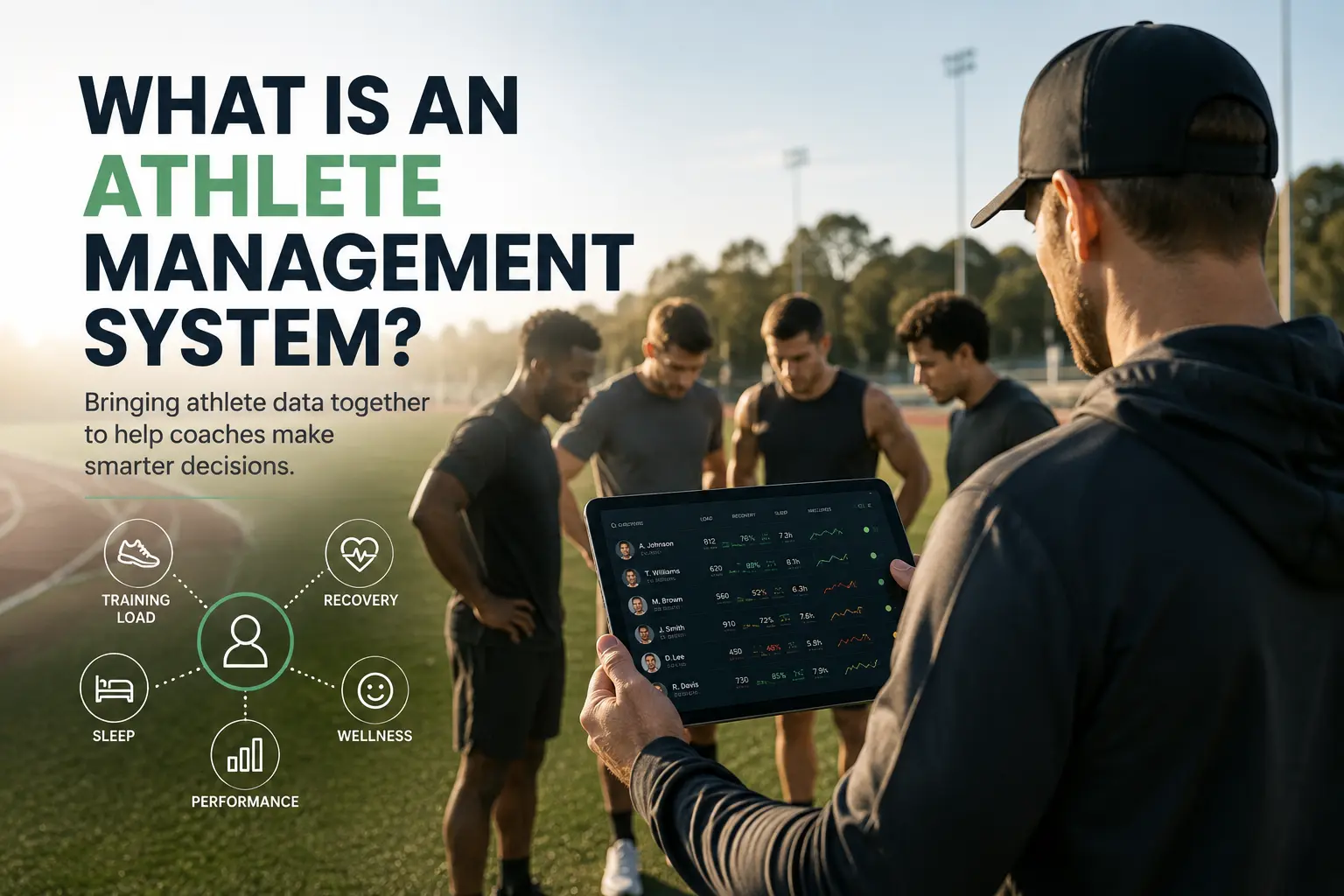
What is an athlete management system, exactly?
An athlete management system, often shortened to AMS, is a central platform used to organise information about athletes and their performance.
Without one, that information can become fragmented. A coach may have workout data in one platform while athletes track sleep through Garmin, Oura or Apple Watch. Strength testing might live in a spreadsheet and wellness surveys somewhere else.
An AMS brings those pieces into a more consistent view.
It overlaps closely with athlete monitoring, but the terms are not exactly interchangeable. Athlete monitoring is the process of tracking training stress, physical response and recovery over time. An AMS is the software infrastructure that can support that process.
As a category, it skews fairly broad. Some systems are centred on training load and performance while others include testing, injury status and athlete availability. The same interface can also be useful for gyms and clinics that manage numerous clients.
What data should teams track?
There is no universal dataset that every team needs. The right metrics depend on the sport and the decisions a coaching staff are trying to make.
Research on monitoring training load and fatigue has consistently emphasised that there is no single metric that gives a complete picture of how an athlete is responding. In practice, monitoring often combines external workload with internal response and subjective feedback.
This is where an AMS can be useful. Instead of relying on one readiness score or isolated metric, coaches can review several signals in context.
| Category | Example data | Context it can provide |
|---|---|---|
| Training load | Duration, distance, power and session RPE | How much work the athlete completed and how hard it felt |
| Recovery | HRV, resting heart rate and readiness | Changes in physiological response between sessions |
| Sleep | Sleep duration, timing and sleep score | Changes in recovery or readiness |
| Wellness | Fatigue, soreness, stress and mood | How the athlete feels |
| Activities | Strength tests, workout history and activity logs | Changes in physical performance |
| Nutrition | Calories, macros, hydration and meal logs | Context around fuelling and recovery |
How teams can use it
The value of an AMS comes from the questions it helps a coaching staff answer.
A coach might want to know which athletes had an unusually demanding week. A player performance director may want to see who has experienced declining sleep quality while training volume increased. A strength coach might compare recent testing with an athlete's pre-season baseline.
If the platform includes AI analysis, staff may also be able to ask questions across entire squad data, such as, "Which athletes have the largest changes from their normal range today, and what is driving those changes?"
This is where combining data becomes more useful than simply having another dashboard.
A lower than normal HRV reading on its own may not tell a coach much. If HRV has fallen for several days while resting heart rate has increased, sleep has declined and the athlete is reporting greater soreness, there is more context worth investigating.
That still does not mean software should decide whether someone trains. Athlete data is most useful when it supports a conversation and adds context to coaching judgement.
Where wearables fit into athlete management
Wearables have made athlete monitoring much more accessible. Smartwatches, rings, heart rate monitors and GPS systems can provide ongoing information about activity, training and physiological response.
The challenge is that athletes do not always use the same device.
One player may wear Garmin. Another may use Oura while a third relies on Apple Watch. Reviewing each company's app and dashboard separately becomes increasingly difficult as a squad grows.
An athlete management system with broad integrations can create a more consistent view across those sources. Sonar Atlas, for example, takes this approach by bringing data from different wearables, health apps and other sources into one platform. This is also where a broader health analytics platform can overlap with traditional athlete management software.
In its consensus statement on injury and illness surveillance, the International Olympic Committee encouraged the use of wearable activity trackers for measuring exposure. It also noted that teams should use devices that are appropriate for the intended purpose and supported by evidence of validity and reliability.
What to look for in an athlete management system
A long feature list does not necessarily make one AMS better than another. Focus on whether the system fits the way your training staff already work.
Device and app integrations
Check whether the platform connects with the devices your athletes already use. Integrating existing sources is much easier than requiring an entire squad to adopt a new wearable.
Individual baselines
Athletes respond differently to the same workload. A useful system should make it easy to compare an athlete with their own previous values instead of relying only on team or population averages.
Useful alerts
Alerts should narrow down where coaches need to look. If every small change creates a warning, important signals can get lost in the noise.
Team-level views
The coaching staff should be able to move from a squad overview into an individual athlete without manually assembling reports from several platforms.
Data access and privacy
Athlete data can include sensitive biometric and health information. Teams should understand who can access the data, how long it is retained and what happens when an athlete leaves the program.
Frequently Asked Questions (FAQ)
What is the difference between an athlete management system and a training load monitoring tool?
A training load monitoring tool is usually narrower. It may focus on metrics such as distance, duration, heart rate, GPS data or session RPE. An athlete management system can bring that information together with wellness data, performance testing, availability and reporting in one platform.
Can an athlete management system help prevent injuries?
An AMS can help staff identify workload changes and other patterns that may deserve attention, but it cannot reliably predict or prevent every injury. Injury risk is multifactorial. Monitoring data should be treated as one source of information alongside athlete feedback, medical input and professional judgement.
Can gyms and clinics use an athlete management system or is it only for pro teams?
Athlete management systems are no longer limited to professional and university sport. Increasingly, gyms, health coaches and longevity clinics are using scaled versions of the same software to track the wellness of their clients over time.
How can AI be used with an athlete management system?
AI can help an athlete management system analyse large amounts of data and surface patterns that might be difficult to spot manually. For example, it can flag changes in sleep, recovery or workload, summarise athlete trends and help staff identify which athletes may need closer review. AI should support coaching and performance decisions rather than make them automatically, especially when the data relates to injury risk or return to play.
How much does an athlete management system cost?
Pricing depends on the number of athletes, the features included and whether the system is built for elite sport or a smaller gym or clinic. Costs range from a flat monthly fee for smaller operations to custom enterprise pricing for pro teams and large athletic departments.
About Sonar
Your body is talking. Are you listening? Sonar unifies all of your wearables, lifestyle, and biomarker data to unlock personalised insights and detection once reserved for elite athletes and biohackers. Trusted by 250,000+ users across 170+ countries, Sonar helps you cut through the noise across sleep, recovery, stress, activity, and nutrition - so you can focus on what actually matters. Sonar isn't just another health tracker. Launched out of Columbia University in New York, it merges the latest medical, sports and data science with AI engines that continuously surface subtle shifts and patterns across millions of data points, helping you know when to push, when to pause, and where to focus next.
More to Explore
Get the latest from Sonar
Share your email to stay up-to-date with all things Sonar
- English (Australia)
- Bahasa Indonesia
- Bahasa Melayu
- Català
- Čeština
- Dansk
- Deutsch
- English
- English (Canada)
- English (UK)
- Español (España)
- Español (Latinoamérica)
- Español (México)
- Français
- Français (Canada)
- Hrvatski
- Italiano
- Magyar
- Nederlands
- Norsk
- Polski
- Português (Brasil)
- Português (Portugal)
- Română
- Slovenčina
- Slovenščina
- Suomi
- Svenska
- Tiếng Việt
- Türkçe
- Ελληνικά
- Русский
- Українська
- עברית
- العربية
- हिन्दी
- ไทย
- 한국어
- 日本語
- 简体中文
- 繁體中文
EN