
What Is Deep Sleep?
Quick answer
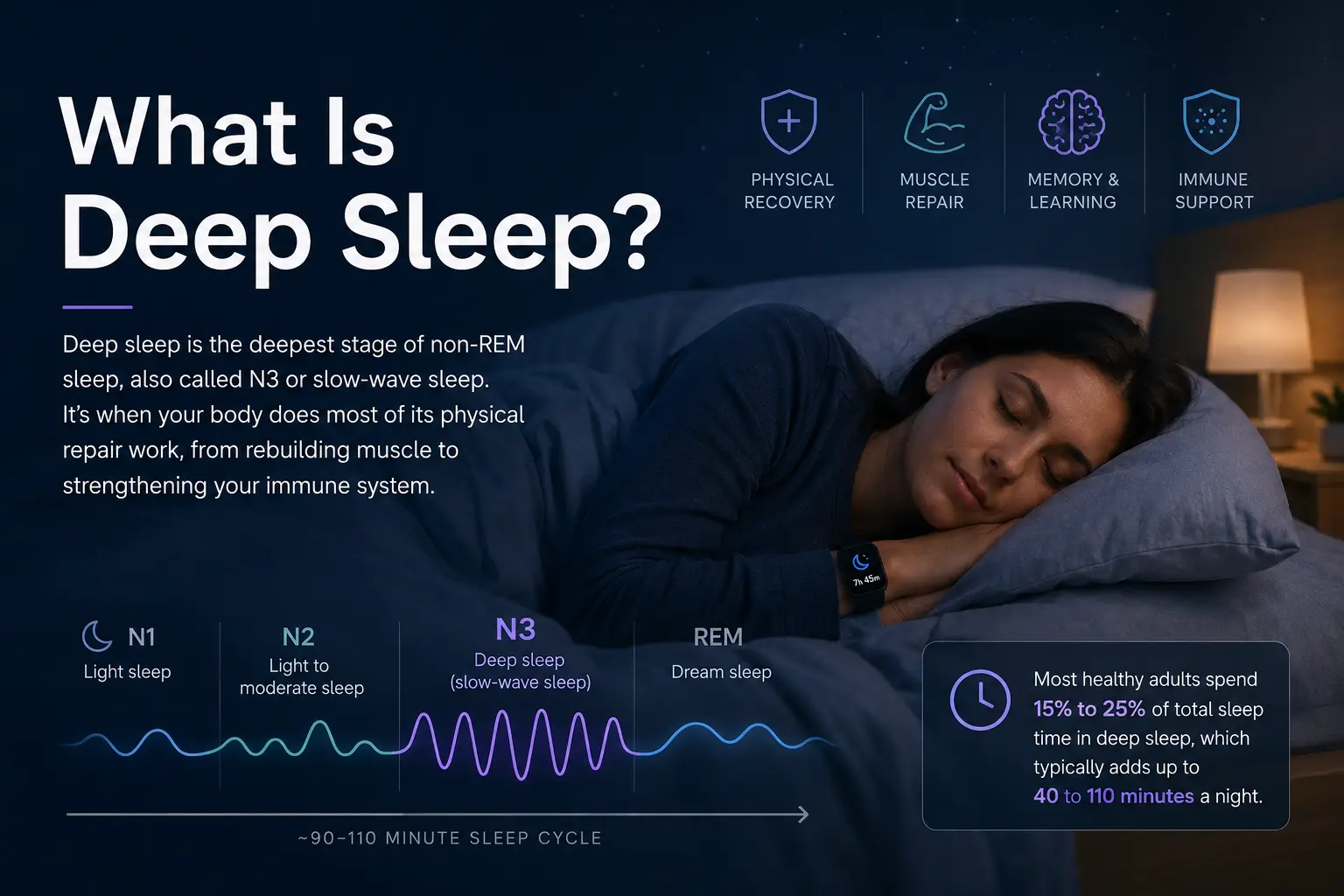
Deep sleep is the deepest stage of non-REM sleep, also called N3 or slow-wave sleep. It's the point in the night when your heart rate and breathing hit their lowest levels and your brain shifts into slow, steady delta waves. This is when your body does most of its physical repair work, from rebuilding muscle to strengthening your immune system. Most healthy adults spend somewhere between 15% and 25% of total sleep time in deep sleep, which usually adds up to 40 to 110 minutes a night.
How does it fit into the sleep cycle
Deep sleep is the third and final stage of non-REM sleep. Sleep is divided into non-REM sleep and rapid eye movement (REM) sleep. Non-REM sleep contains three stages with N3 representing deep sleep.
The body moves through a complete sleep cycle roughly every 90 to 110 minutes. Most people go through four to six cycles during a night. Deep sleep tends to be concentrated earlier in the night, while REM sleep becomes more prominent later.
Here is how deep sleep fits into the overall sleep cycle:
| Stage | What it means | What is happening |
|---|---|---|
| N1 | Light sleep | The drift into sleep. Breathing and heartbeat start to slow and muscles relax. |
| N2 | Light to moderate sleep | Body temperature drops and the brain shows short bursts of activity called sleep spindles. You spend more time here than any other stage. |
| N3 (deep sleep) | Deep sleep | Slow-wave brain activity becomes prevalent and sleep is harder to interrupt. |
| REM | Dream sleep | Brain activity picks back up close to waking levels. Most dreaming happens here while muscles stay temporarily still. |
What happens during deep sleep?
Deep sleep is often described as being very restorative because several recovery processes are associated with slow-wave sleep.
Research has linked slow-wave sleep with memory processing and the consolidation of information learned while awake. It is also associated with hormonal and physiological changes that support recovery throughout the body.
Deep sleep is also closely connected with the body's immune and endocrine systems. Research has found that sleep helps regulate immune responses, while slow-wave sleep is associated with increased growth hormone release.
This does not mean deep sleep is the only important stage. N1, N2, N3 and REM sleep all serve different functions. Healthy sleep depends on moving through the full sleep cycle rather than maximizing one stage.
How much does a typical person need?
There is no universal recommendation for a specific number of minutes of deep sleep each night.
Deep sleep varies naturally between people and changes throughout life. The amount of slow-wave sleep is highest during childhood, falls considerably during the teenage years and generally continues to decline with age.
For that reason, it usually makes more sense to focus on getting enough total sleep rather than trying to hit a specific deep sleep percentage. The CDC recommends that adults ages 18 to 60 get at least seven hours of sleep each day. Sleep needs vary somewhat for other age groups.
If you track your sleep with a wearable, it can also help to understand what a good sleep score looks like since deep sleep is only one part of the overall picture.
Getting more of it
A few habits tend to move the needle more than anything else:
- Keep a consistent bedtime and wakeup time, even on weekends
- Keep the bedroom cool, dark and quiet
- Cut back on alcohol and caffeine, especially later in the day
- Get regular exercise, preferably not right before bed
- Wind down screens and bright light at least 30 minutes before sleep
Frequently Asked Questions (FAQ)
Is deep sleep the same as REM sleep?
No. Deep sleep is stage N3 of non-REM sleep. REM is a separate stage when brain activity becomes more similar to waking activity and most dreaming occurs. Deep sleep is more common earlier in the night, while REM periods tend to become longer later.
How much deep sleep is normal?
There is no single amount that is normal for everyone. Deep sleep changes with age and can vary from night to night. It generally decreases as people get older.
Is more deep sleep always better?
Not necessarily. The goal is not to maximize one sleep stage. Healthy sleep involves cycling through non-REM and REM sleep throughout the night.
Do wearables accurately measure deep sleep?
They're useful for spotting trends but are less precise than a clinical sleep study because most wearables estimate sleep stages using heart rate and movement rather than brain activity. If sleep tracking is a priority when choosing a wearable, our guide to choosing the right fitness tracker covers some of the differences between popular options.
If you use more than one wearable or health app, Sonar is one option for bringing that data into one place so you can look at sleep alongside recovery, workouts and other health trends over time.
About Sonar
Your body is talking. Are you listening? Sonar unifies all of your wearables, lifestyle, and biomarker data to unlock personalized insights and detection once reserved for elite athletes and biohackers. Trusted by 250,000+ users across 170+ countries, Sonar helps you cut through the noise across sleep, recovery, stress, activity, and nutrition - so you can focus on what actually matters. Sonar isn't just another health tracker. Launched out of Columbia University in New York, it merges the latest medical, sports and data science with AI engines that continuously surface subtle shifts and patterns across millions of data points, helping you know when to push, when to pause, and where to focus next.
More to Explore
Get the latest from Sonar
Share your email to stay up-to-date with all things Sonar
- English
- Bahasa Indonesia
- Bahasa Melayu
- Català
- Čeština
- Dansk
- Deutsch
- English (Australia)
- English (Canada)
- English (UK)
- Español (España)
- Español (Latinoamérica)
- Español (México)
- Français
- Français (Canada)
- Hrvatski
- Italiano
- Magyar
- Nederlands
- Norsk
- Polski
- Português (Brasil)
- Português (Portugal)
- Română
- Slovenčina
- Slovenščina
- Suomi
- Svenska
- Tiếng Việt
- Türkçe
- Ελληνικά
- Русский
- Українська
- עברית
- العربية
- हिन्दी
- ไทย
- 한국어
- 日本語
- 简体中文
- 繁體中文
EN