
Why the Best Functional Medicine Software Covers the Time Between Visits
Quick Summary
The most useful functional medicine software should do a lot more than chart appointments and order labs. Ideally, the practitioner should have visibility into what happens to a patient during the weeks between visits, when protocols either take hold or stall out. Tapping into wearable data from your clients can help fill that gap as it shows whether a plan is working long before their next visit.
The Appointment Is a Snapshot. Functional Medicine Is a Timeline.
Functional medicine asks a lot of the patient like changing how they eat, sleep or move. It’s then the practitioner's job to watch how those aspects of a client’s life progress over an extended period of time. The length of that time period is important. Cleveland Clinic researchers compared 7,252 patients from their functional medicine center with similar patients seen in primary care. Their findings in JAMA Network Open showed the functional medicine group made bigger gains in physical health after six months with the gap still being there at twelve.
Those gains are the accumulation of months of daily choices. Obviously, they did not come from the hour spent in an exam room. Yet most functional medicine software is organized around that hour. Charting captures what was discussed. Labs capture a single physical state. Everything in between depends on the patient's memory or a survey that was haphazardly filled out in the waiting room.
It’s crucial to see the complete picture of your client so you can handle the various complexities that arise. According to the CDC, three in four American adults have at least one chronic condition and over half have two or more. Complex cases generate a lot of signals between appointments and most practices never see it.
The Data Already Exists. It Just Never Reaches the Chart.
Wearables are becoming more commonplace for adults as we covered in our wearable adoption snapshot. People are also more willing to share that data with their care team. An analysis of national survey data found 78.4% of wearable users were willing to share their data with health care providers yet only 26.5% had actually done so highlighting a steep discrepancy.
It’s clear that this gap is more of a software problem than a patient problem. When sharing equates to cropped screenshots sent via an archaic portal messaging service, very little of it gets actioned on. In our conversations with users, people consistently ask for a seamless user experience from which to share their data and expect some form of automation. They also want transparency on their end to see how that data is being used to inform health related decisions.
Audit Your Functional Medicine Software Stack
Most practices already run several tools. The question is which layer covers the time between visits.
| Stack layer | What it does well | What it misses between visits |
|---|---|---|
| EHR and charting | Visit notes and patient history | Only knows what the patient reports in the room |
| Practice management | Scheduling and billing | Cannot tell who is struggling before they cancel |
| Lab ordering | Deep biomarker panels | Reflects one draw every few months |
| Patient portal | Messaging and intake forms | Manual, archaic process that relies on patients to notice and report changes |
| Protocol and supplement tools | Plan delivery and refill reminders | Tracks what was prescribed rather than how the body responded |
| Continuous data layer | Daily sleep and recovery trends | Very little once every device is synced and the data is unified |
If that last layer currently doesn’t exist at your practice, every other tool is working off partial information.
Four Questions to Ask Before Adding Another Tool
Does it work with the devices your clients already wear?
Due to the rising popularity of wearables and smartrings, there has been an influx in the variety of devices on the market. It’s not practical to ask every client in your care to switch hardware in order to tap into this level of real-time monitoring. Broad support for integrations decides whether or not the data shows up at all.
Does it place wearable trends next to labs and biomarkers?
A falling resting heart rate means more when you can see it beside an improving lipid panel. That’s why having a unified view can make identifying trends and patterns over time a lot easier.
Does it tell you who needs attention?
Nobody has time to review 200 patients' sleep charts every morning. Good software surfaces the handful of people whose trends have deviated from their baselines and uses AI to interpret wearable data.
Does it give your clients control?
People are inclined to share more when they understand what is collected and who sees it. Clear consent and simple controls over which metrics are exposed help build the trust that keeps data flowing.
What Between-Visit Data Looks Like in Practice
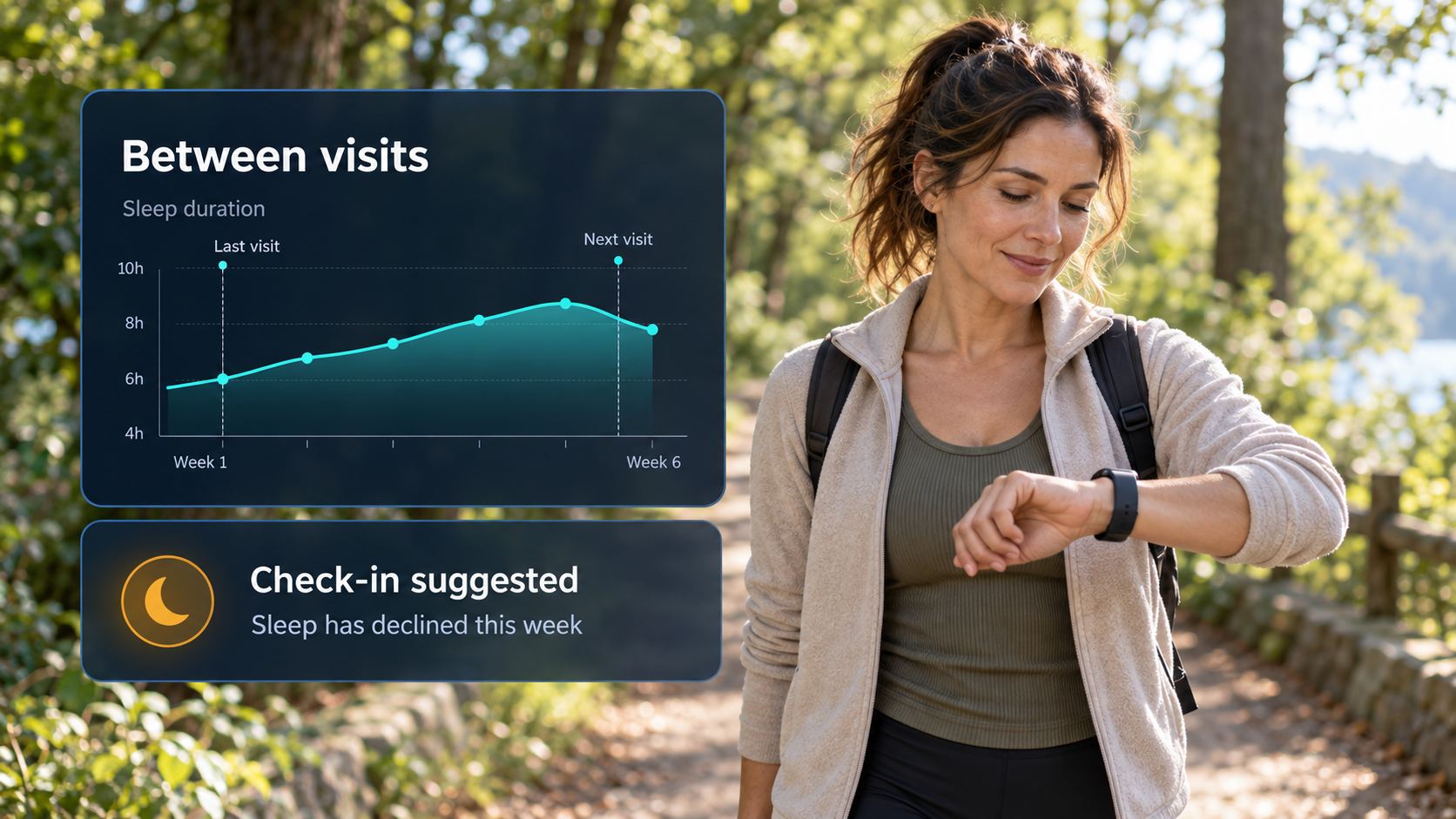
Picture a patient six weeks into a protocol for low energy. At her follow-up she says she feels about the same. But when you loop in her wearable history, it tells a fuller story. Her sleep duration improved steadily for the first month. Then it dropped during a stretch of late nights around a work deadline and her recovery scores followed suit.
That changes the conversation. Instead of adjusting the protocol, the practitioner can point to what was working and talk about protecting it during stressful weeks. Patients who see that link tend to engage more with their own plans, an idea we explore further in how to turn wearable data into a personal longevity protocol.
See what happens between visits
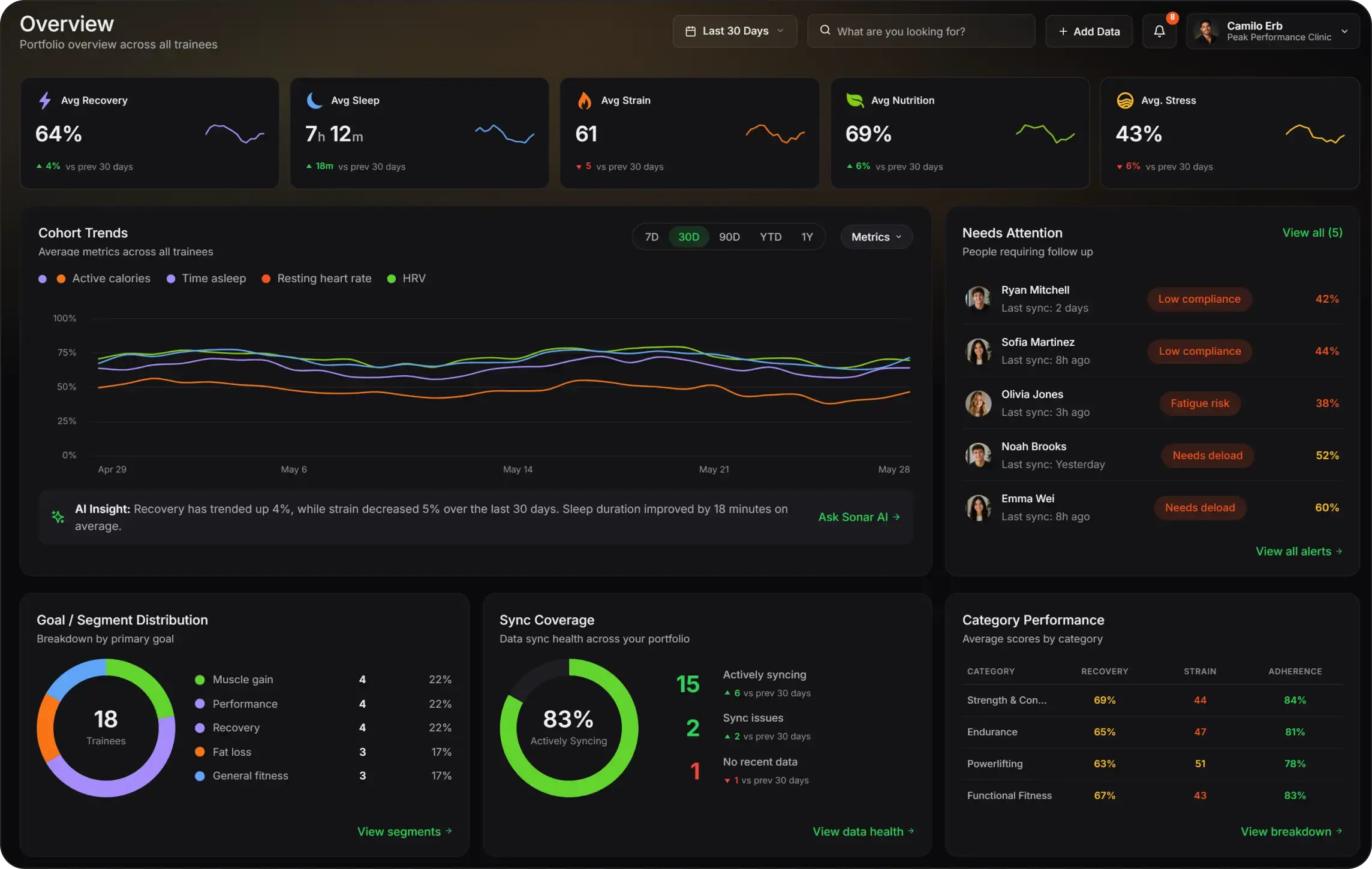
Sonar Atlas gives your practice the continuous data layer most functional medicine stacks are missing. It syncs 600+ wearables and apps into one real-time dashboard alongside labs and biomarkers, then flags the clients whose trends have shifted so you know who needs attention before their next appointment.
About Sonar
Your body is talking. Are you listening? Sonar unifies all of your wearables, lifestyle, and biomarker data to unlock personalized insights and detection once reserved for elite athletes and biohackers. Trusted by 250,000+ users across 170+ countries, Sonar helps you cut through the noise across sleep, recovery, stress, activity, and nutrition - so you can focus on what actually matters. Sonar isn't just another health tracker. Launched out of Columbia University in New York, it merges the latest medical, sports and data science with AI engines that continuously surface subtle shifts and patterns across millions of data points, helping you know when to push, when to pause, and where to focus next.
More to Explore

September 18, 2026
Get the latest from Sonar
Share your email to stay up-to-date with all things Sonar
- English
- Bahasa Indonesia
- Bahasa Melayu
- Català
- Čeština
- Dansk
- Deutsch
- English (Australia)
- English (Canada)
- English (UK)
- Español (España)
- Español (Latinoamérica)
- Español (México)
- Français
- Français (Canada)
- Hrvatski
- Italiano
- Magyar
- Nederlands
- Norsk
- Polski
- Português (Brasil)
- Português (Portugal)
- Română
- Slovenčina
- Slovenščina
- Suomi
- Svenska
- Tiếng Việt
- Türkçe
- Ελληνικά
- Русский
- Українська
- עברית
- العربية
- हिन्दी
- ไทย
- 한국어
- 日本語
- 简体中文
- 繁體中文
EN